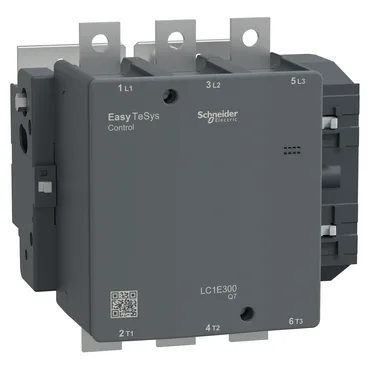
Its headline rating is 220 kW at 660/690 V AC in AC-3 duty. The AC-3 and AC-4 utilisation categories mean this contactor is rated for starting and stopping squirrel-cage motors under full load (AC-3) and for inching/plugging duty (AC-4). The electrical durability is 500,000 cycles in AC-3 and 400,000 cycles in AC-1, with a mechanical endurance of 5 million cycles. For a panel builder, the 1200 cycles/hour maximum operating rate at 55 °C sets the switching frequency ceiling in a motor control centre.
This contactor carries approvals to EN/IEC 60947-1, EN/IEC 60947-4-1, GB/T 14048.1, and GB/T 14048.4. The associated fuse rating is 500 A gG at ≤ 690 V for type 1 coordination — meaning a short-circuit fault clears without damaging the contactor but the contactor may need replacement after the event. For type 2 coordination (contactor remains usable after a fault), a different fuse selection or a current-limiting breaker is required. This matters for maintenance spares planning.
Integration constraints
At 219 mm deep, 213 mm wide, and 206 mm tall, this contactor occupies a substantial footprint on the backplate. The power circuit accepts cable lugs up to 240 mm² or busbars up to 5 x 30 mm cross-section — typical for the 300 A class. Control circuit terminals are screw-clamp, accepting 1 to 4 mm² solid or 1 to 2.5 mm² flexible with ferrule. Heat dissipation is 8 W for the control circuit and 27 W per pole in AC-3 (31 W per pole in AC-1). For a panel with multiple contactors in close proximity, the cumulative heat load must be factored into the cabinet ventilation design.
Field service notes
Closing time is 40 to 65 ms; opening time is 100 to 170 ms. For a controls integrator sequencing contactors in a motor starter, the 100 ms minimum opening time means the arc is extinguished before the next contactor closes in a reversing or star-delta scheme. The inrush power is 650 VA at both 50 and 60 Hz, cos φ 0.9 — relevant for sizing the control transformer. Rated making capacity is 3000 A at 440 V AC; rated breaking capacity is 2400 A at 440 V AC — both conforming to IEC 60947-4-1. Above that, the dielectric strength and air circulation degrade, so the contactor must be derated per IEC 60947-1 guidelines. The fire resistance is 850 °C conforming to IEC 60695-2-1, which is the glow-wire test for flammability — relevant for compliance with equipment safety standards.