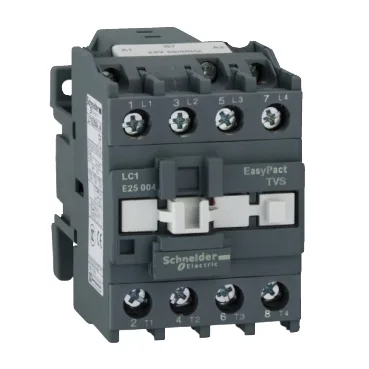
Its headline rating is 55 A at ≤ 415 V AC for the power circuit — that is the current it can carry continuously in a resistive heating or lighting application, not a motor-starting curve. The control circuit is a 415 V AC 50 Hz wide-range coil, with pull-in at 0.7 to 1.25 Uc and drop-out between 0.3 and 0.6 Uc across the -5 to 55 °C ambient band. The 4 NO pole configuration means it switches four independent circuits simultaneously — useful for multi-stage resistive banks or as a main contactor on a three-phase line with a neutral leg. No auxiliary contacts are built in, so if you need feedback or a holding circuit, plan for an external aux block.
The power dissipation per pole is 5 W under AC-1 duty, so the total heat load in the panel is about 20 W for all four poles plus 2 to 3 W from the coil — a modest figure that won't force a bigger enclosure. The rated breaking capacity of 256 A at 440 V and making capacity of 320 A at 440 V give it headroom for occasional overloads, but this is not a motor contactor; for AC-3 motor duty you would need a different rating. The insulation voltage is 690 V, so it can live on a 400 V or 480 V system with margin.
That covers the product standard for contactors and motor-starters, including the thermal and short-circuit performance tests.
Mechanical and electrical endurance
Mechanical durability is rated at 8 million cycles — the contactor will outlast most machines it goes into. Electrical durability under AC-1 load is 350,000 cycles, which is typical for a resistive-duty contactor. The maximum operating rate is 1,800 cycles per hour at 60 °C, so it can handle fast cycling in a process heater or oven application.