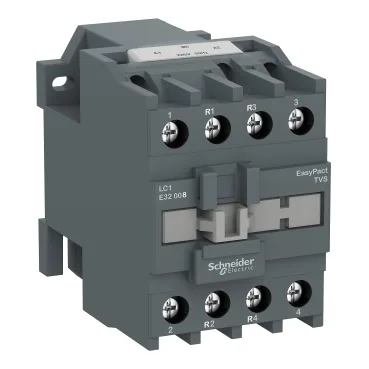
Its rated operational current is 45 A at ≤440 VAC, making it a straight swap for panel builds that need a 4-pole block on resistive duty. The coil is 415 VAC at 50 Hz, wide-range type, with a 95 VA inrush at 20 °C and 2–3 W heat dissipation on the control circuit. Pull-in range is 0.7–1.25 Uc; drop-out is 0.3–0.6 Uc across -5 to 55 °C.
Mounts on DIN rail or a plate — your call. The 56 mm wide, 84 mm tall, 93 mm deep footprint fits standard panel layouts. Screw-clamp terminals on both power and control circuits; power side takes 1–6 mm² flexible with end, control side takes 1–4 mm². Tighten power terminals to 2.1 N·m, control to 1.2 N·m. That means it's rated for fixed-installation panels in industrial environments where transient overvoltages are expected. IP20 finger-safe on the front; keep it inside a cabinet.
That's not a motor-rating figure; for motor loads you'd need the AC-3 rating, which isn't listed here. The 350,000 electrical cycles at AC-1 and 8 million mechanical cycles give a solid service life for a panel that cycles a few times per hour. Associated fuse is 63 A gG at ≤690 V, coordination type 1. That's the maximum overcurrent protection the contactor can clear without damage to itself — upstream breaker or fuse sizing should respect that limit. Operating rate is 1800 cycles per hour at 60 °C, so it handles fast cycling in a packaging or conveyor line without derating. Altitude rating of 3000 m without derating covers most installations outside high-mountain sites.
That covers the main industrial controlgear standards for contactors.