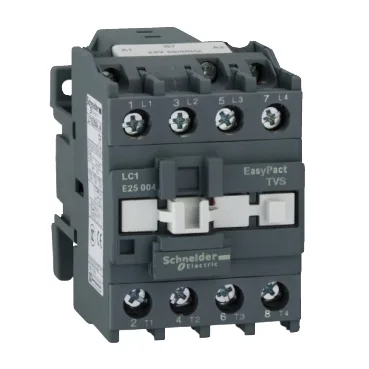
The Schneider Electric LC1E32008N5WBIN is a 4-pole contactor from the Easy TeSys Control range, rated for 55 A in AC-1 utilisation category at ≤415 V AC. That AC-1 rating means it is designed for resistive loads — heaters, lighting banks, or other non-inductive circuits — where the current inrush is minimal and the switching duty is steady-state. The control circuit is a 415 V AC 50 Hz wide-range coil, with a drop-out threshold of 0.3...0.6 Uc and operational range of 0.7...1.25 Uc across -5 to 55 °C. Screw-clamp terminals on both power and control circuits accept up to 10 mm² solid or 6 mm² flexible with cable end on the power side.
The headline 55 A at ≤415 V AC AC-1 is the continuous current the contactor can carry in resistive service. For motor loads (AC-3 duty), the rating would be lower — this part is not specified for AC-3, so do not use it to switch induction motors unless you derate significantly and verify the application. The rated breaking capacity is 256 A at 440 V, and the making capacity is 320 A at 440 V AC, both per IEC 60947-4-1, which tells you the contactor can handle occasional overloads during switching without welding. The 4-pole configuration gives 2 NO + 2 NC main poles, with no auxiliary contacts built in. If you need auxiliaries for feedback or interlocking, you will add a separate block. The electrical durability is 350,000 cycles at AC-1, and mechanical durability is 8 million cycles — the mechanical life far exceeds the electrical life, so the contactor will wear out from arcing long before the mechanism fails.
The contactor is rated IP20, so it is suitable for installation inside a closed panel only — not for washdown or outdoor locations without an additional enclosure. The tightening torque is 1.2 N·m on the control circuit and 2.1 N·m on the power circuit; use a torque screwdriver to avoid terminal damage. Heat dissipation is 2 to 3 W for the control circuit and 5 W per pole in AC-1 duty. The associated fuse rating is 63 A gG at ≤690 V, coordination type 1, which protects the power circuit against short circuits without damaging the contactor.