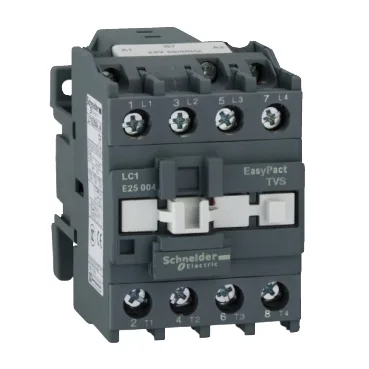
It is rated for AC-1 utilisation category at 55 A up to 415 V, with a 230 V coil — meaning it is designed for switching resistive loads such as heaters or lighting banks, not motor starting. The permissible ambient air temperature around the device spans -20 to 70 °C at Uc, with storage from -60 to 80 °C and operation from -5 to 55 °C. Fire resistance is rated at 850 °C conforming to IEC 60695-2-1, and protective treatment is TH (pollution degree 3) per IEC 60068, so it handles typical industrial atmospheres with conductive dust or humidity.
AC-1 covers non-inductive or slightly inductive loads — resistive heaters, incandescent lighting, or resistive banks — where the current inrush is minimal. This is not an AC-3 motor-switching contactor; if your application involves starting a motor, the AC-1 rating does not apply, and you would need a contactor rated for AC-3 duty at the motor's full-load current. The 4-pole configuration with 2NO+2NC gives flexibility for switching both phases and a neutral, or for interlocking control circuits on the NC poles. Mechanical robustness is specified for vibration and shock: 1.5 Gn (5-300 Hz) with the contactor open, 3 Gn (5-300 Hz) closed, and shock ratings of 10 Gn for 11 ms closed and 6 Gn for 11 ms open. These figures confirm the contactor can withstand typical industrial panel vibration from adjacent contactors or drives without nuisance dropout. Operating altitude is rated to 3000 m, which is standard for most installations below that elevation.