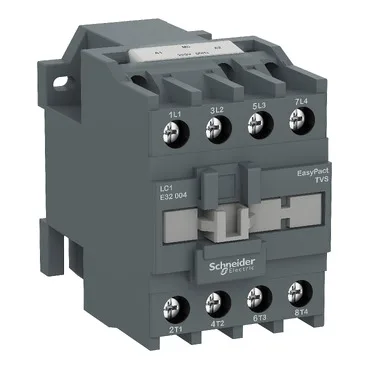
It carries a rated operational current of 50 A at ≤415 V AC for the power circuit, meaning it's sized for heater banks, lighting, or other non-inductive loads where the current curve stays close to resistive. The 415 V AC 50 Hz control coil is a wide-range AC type, so it holds in across a band of supply variation — drop-out happens between 0.3 and 0.6 Uc, and pick-up between 0.7 and 1.25 Uc at -5 to 55 °C. Pole configuration is 4 NO with no auxiliary contacts built in — if you need N/C aux or signalling, you'll add a separate block. Screw clamp terminals accept up to 10 mm² solid or flexible with ferrule on the power side, and up to 4 mm² on the control side.
That is not a motor rating — AC-1 covers resistive loads where the power factor is near unity, so the contactor sees lower arc stress than AC-3 motor duty. The associated fuse recommendation is 63 A gG at ≤690 V coordination type 1 for the power circuit, which tells the panel builder what upstream protection to pair with it for a type-1 short-circuit coordination. Rated breaking capacity is 304 A at 440 V, and rated making capacity is 380 A at 440 V AC, both per IEC 60947-4-1. That means the contactor can close onto and interrupt fault currents well above its continuous rating — important for withstanding occasional overloads or short-circuits until the upstream fuse clears. Electrical durability is 350,000 cycles under AC-1, and mechanical durability is 8 million cycles, so in a low-cycle resistive switching application (like a furnace or oven), the electrical life is the limiting factor, not the mechanical one. The IP20 finger-safe enclosure suits panel-mount use where the contactor is behind a cabinet door.
The contactor complies with EN/IEC 60947-1, EN/IEC 60947-4-1, and EN/IEC 60947-5-1, plus the Chinese GB/T equivalents. Operating altitude is rated to 3,000 m without derating.
Tightening torque is 1.2 N·m for control circuit terminals and 2.1 N·m for power circuit terminals — use a torque screwdriver to avoid crushing the conductor or loosening over time. Mechanical robustness is specified: vibrations at 1.5 Gn (contact open) and 3 Gn (closed) over 5–300 Hz, and shocks at 6 Gn (open) and 10 Gn (closed) for 11 ms — adequate for industrial machinery with moderate vibration.