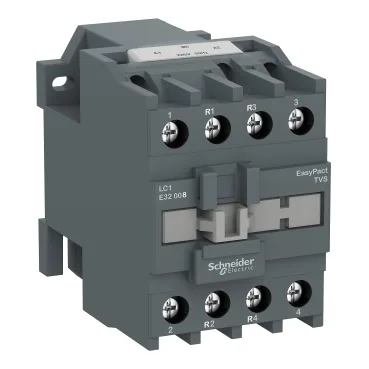
Its headline rating is 50 A rated operational current in AC-1 utilisation category at ≤415 V — that's the current it can make and break on resistive heater, oven, or lighting circuits, not motor loads. The coil pulls 220 V AC at 50 Hz, with a wide-range control circuit that picks up at 0.7 to 1.25 Uc and drops out between 0.3 and 0.6 Uc.
The 50 A AC-1 rating is the resistive load curve. If you're switching a resistive bank, that's your continuous current. Breaking capacity is 304 A at 440 V — that's the fault-clearing capability before the upstream fuse or breaker needs to take over. The associated fuse recommendation is 63 A gG at ≤690 V for type 1 coordination. Overvoltage category III suits fixed installations with transient overvoltages up to 4 kV.
Complies with EN/IEC 60947-1, 60947-4-1, and 60947-5-1, plus the Chinese GB/T equivalents. Protective treatment is TH per IEC 60068 for tropical environments. Operating altitude up to 3,000 m without derating.
Wiring and installation notes
Power circuit terminals accept 1 to 10 mm² solid or 1 to 6 mm² flexible with cable end; tighten to 2.1 N·m. Control circuit terminals take 1 to 4 mm² solid or flexible; tighten to 1.2 N·m. The contactor has 2 NO + 2 NC main poles and no auxiliary contacts built in — you'll need a separate auxiliary block if you need feedback or interlocking. Heat dissipation is 2 to 3 W for the control circuit and 5 W per pole in AC-1 duty. That's about 22 W total at full load — factor that into your panel thermal calculation if you're packing several contactors in a small enclosure.