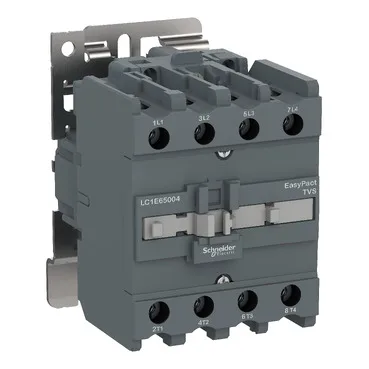
The control circuit is a 220 V AC 50 Hz wide-range coil that pulls 160 VA inrush at cos φ 0.75. The contactor is supplied without auxiliary contact blocks, so any auxiliary switching (status feedback, interlocking) must be added externally. The main poles are 4 NO (normally open), meaning all four power paths close when the coil is energised.
For motor loads (AC-3), this contactor is not rated — the evidence only lists AC-1 utilisation, so it should be specified only for resistive or low-inrush loads. The rated breaking capacity of 320 A at 440 V and making capacity of 400 A at 440 V confirm it can handle occasional overloads on closing and opening within the AC-1 duty cycle. Mechanical durability is 5 million cycles; electrical durability under AC-1 is 350,000 cycles. That electrical life figure is the practical limit for a continuously cycled resistive load — plan maintenance intervals around it. The maximum operating rate of 1200 cycles per hour at 60 °C means it can keep pace with a fast-cycling oven or packaging line heater bank. The IP20 finger-safe enclosure is standard for panel-mount gear — not for washdown or outdoor use without an additional enclosure.
Power circuit terminals accept 2.5 to 25 mm² solid or flexible wire with cable ends; control circuit terminals take 1 to 4 mm². Tightening torques are 5 N·m for power and 1.2 N·m for control, so a torque screwdriver is needed for the power connections. Heat dissipation runs 6 to 10 W for the control circuit alone, plus 5.4 W per pole under AC-1 load. In a densely packed panel, that heat adds up — ensure adequate ventilation or derating if ambient exceeds 40 °C.
The contactor complies with EN/IEC 60947-1, EN/IEC 60947-4-1, and EN/IEC 60947-5-1, plus the Chinese GB/T equivalents. It carries TH protective treatment per IEC 60068 for tropical environments. Operating altitude is rated to 3000 m without derating.