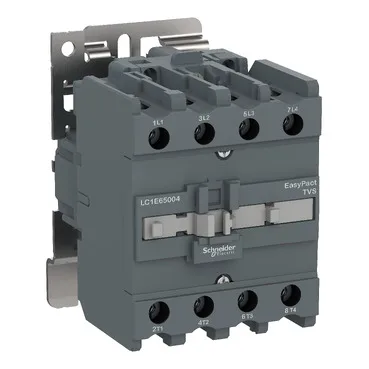
Its 60 A rated operational current in AC-1 utilisation category (resistive load, ≤440 V) defines the continuous current it can carry in heating, lighting, or other non-inductive circuits. The 415 V AC 50 Hz coil is a wide-range control circuit type, with pickup at 0.7 to 1.25 Uc and dropout at 0.3 to 0.6 Uc across the -5 to 55 °C ambient band. Mounts on either a plate or a DIN rail, so it fits standard panel layouts.
The headline 60 A AC-1 rating is the continuous resistive load it handles. That is not a motor rating — AC-1 is for resistive loads like heaters or lighting banks. For motor duty (AC-3), you would need a different coil or a larger frame. The 1.5 mOhm average impedance per pole at 60 A 50 Hz means about 5.4 W dissipation per pole at full load, which sums to 21.6 W across the four poles — a figure to check against your enclosure's thermal budget. Breaking capacity is 320 A at 440 V, and making capacity is 400 A at 440 V AC per IEC 60947-4-1. That is the fault-clearing ability — it can interrupt a short-circuit up to that level, but coordination with an upstream 80 A gG fuse (type 1 coordination) is specified for the power circuit. Mechanical durability is 5 million cycles; electrical durability under AC-1 load is 350,000 cycles. The maximum operating rate is 1200 cycles per hour at 60 °C, so it handles frequent switching in process applications.
Protective treatment TH per IEC 60068 means it is tested for tropical/humid conditions. Fire resistance is 850 °C per IEC 60695-2-1.