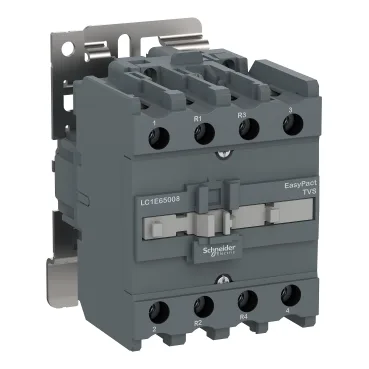
For motor duty, you'd need the AC-3 rating, which this part does not list.
The 75 A AC-1 rating at 40 °C ambient is the headline number. AC-1 covers resistive loads where the current is in phase with voltage — no high inrush like a motor. The rated breaking capacity is 320 A at 440 V, and the rated making capacity is 400 A at 440 V AC, both conforming to IEC 60947. That tells you the contactor can close onto and interrupt fault currents well above its continuous rating, which matters for coordination with upstream protection. The coil is 220 V AC 50 Hz, wide-range type, with a drop-out threshold of 0.3 to 0.6 Uc and an operational range of 0.7 to 1.25 Uc. Inrush power is 160 VA at 50 Hz, cos phi 0.75, at 20 °C. Steady-state heat dissipation for the control circuit runs 6 to 10 W. That's enough to matter in a densely packed panel — account for the thermal load when sizing the enclosure. Pole configuration is 2 NO + 2 NC, with no auxiliary contacts built in. If you need auxiliaries for status feedback or interlocking, you'll add them separately.
Dimensions are 85 mm wide, 127 mm high, 110 mm deep — that's a compact footprint for a 75 A 4-pole contactor. Power circuit terminals accept solid or flexible cable: 2.5 to 25 mm² with a cable end, or 2.5 to 16 mm² solid. Tightening torque is 5 N.m on the power side, 1.2 N.m on the control side. The associated fuse rating for type 1 coordination is 80 A gG at up to 690 V. That's the maximum fuse you can put upstream and still have the contactor survive a short circuit without replacement.
Durability and environmental specs
Electrical durability is 350,000 cycles in AC-1 duty. Mechanical durability is 5 million cycles. That's a long service life for a resistive-load contactor — you'll likely retire the panel before the contactor wears out. Maximum operating rate is 1,200 cycles per hour at 60 °C. Operating altitude is 3,000 m without derating. Mechanical robustness: the contactor withstands 1.5 Gn vibration when open, 3 Gn when closed, and shocks of 6 Gn open, 7 Gn closed. Fire resistance is 850 °C conforming to IEC 60695-2-1. Protective treatment is TH conforming to IEC 60068, meaning it's protected against tropical humid conditions.