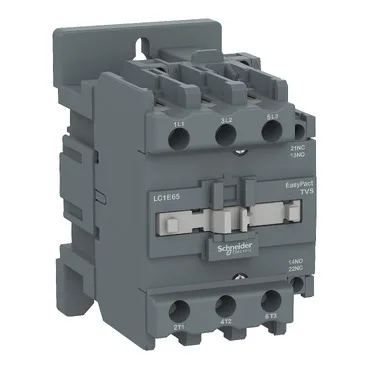
The LC1E40B01M5WB is an Easy TeSys contactor from Schneider Electric — a 3-pole (3 NO) device rated for AC-3 duty at 50 A on 400 V, with a 220 V AC wide-range coil. That AC-3 rating means it's sized for motor switching: starting and stopping squirrel-cage induction motors under load, which is the most common contactor job in a control panel. The same part also carries AC-1 and AC-3e utilisation categories, so it handles resistive heating loads and high-efficiency motor starts as well. Mounts on either a DIN rail or a plate, which gives the panel builder flexibility — snap it on a 35 mm rail for quick replacement, or screw it to a backplate in a fixed-assembly layout.
This contactor carries EN/IEC 60947-4-1 (the main standard for contactors and motor-starters) plus EN/IEC 60947-1 and -5-1 for general rules and control-circuit devices. The GB/T equivalents (GB/T 14048.1.4.5) cover the Chinese GB market — important if your equipment ships to or is built in China. It also references EN/IEC 60335-1 Clause 30.2 and 60335-2-40 Annex JJ, which are the glow-wire and fire-resistance tests for household-appliance safety. The 850 °C glow-wire rating per IEC 60695-2-1 means the plastic body won't sustain a flame if a hot fault lands on it — a real consideration for UL 508A panel listings. Operating altitude goes to 3000 m without derating, which covers most sites except high-mountain installations.
Mechanical endurance and environmental limits
The contactor is rated for vibration resistance: 1.5 Gn from 5 to 300 Hz when open, 3 Gn when closed. Shock resistance is 10 Gn for 11 ms when closed, 6 Gn when open. These numbers matter if the contactor sits on a conveyor drive or a machine base that sees regular starts and stops — the armature stays latched through the bumps. The -20 °C to 70 °C range at Uc applies to the coil voltage, not the full device — so if you're starting a cold pump house at -10 °C, the coil will still pull in.
At 86 mm deep, 56 mm wide, and 84 mm tall, this is a compact 3-pole contactor — fits a standard 45 mm wide DIN-rail footprint with some side clearance for wiring. The depth includes the coil terminals and arc chamber; allow 100 mm in front for finger access to the screw terminals. If you're replacing an older TeSys D or F contactor, check the mounting hole pattern — the Easy TeSys uses a different base, so a DIN-rail adapter plate may be needed for a direct swap.