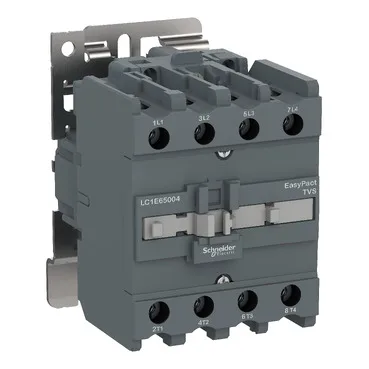
Its 85 A rated operational current (at ≤415 V AC, <40 °C) makes it a fit for heater banks, lighting circuits, or other non-inductive loads where the current is steady and inrush is low. The coil is 220 V AC at 50 Hz, wide-range control circuit type, with a 160 VA inrush at 20 °C and 6–10 W heat dissipation in steady state. Drop-out voltage is 0.3–0.6 Uc, operational pick-up is 0.7–1.25 Uc across the -5 to 55 °C range. Mounts on DIN rail or a plate, with screw-clamp terminals on both power and control circuits. Power terminals accept 2.5–25 mm² flexible with cable end, control terminals 1–4 mm². Tightening torque is 5 N.m on the power side, 1.2 N.m on control.
The 85 A AC-1 rating is the continuous resistive current the contactor can carry without exceeding its thermal limits. For motor loads (AC-3 duty), you would need to derate — this part is not specified for AC-3, so it is best kept on resistive or lightly inductive circuits where the switching arc is less severe. The rated breaking capacity is 520 A at 440 V, and the making capacity is 650 A at 440 V AC — both per IEC 60947, confirming it can close into and interrupt fault currents within its rating. Mechanical durability is 5 million cycles; electrical durability is 350,000 cycles at AC-1. Maximum operating rate is 1200 cycles per hour at 60 °C. The associated fuse recommendation is 125 A gG at ≤690 V, coordination type 1. IP20 protection keeps fingers out but does not seal against dust or moisture — install inside a panel.
For BOM freeze or long-term planning, the IEC 60947 compliance and multiple national standards (GB/T 14048 series) mean the part is accepted across European and Chinese regulatory frameworks. No successor or replacement part is flagged — the current code is the active variant.
Dimensions are 127 mm height, 85 mm width, 125 mm depth — a compact 4-pole footprint that fits standard DIN-rail enclosures. The contactor has no auxiliary contact block fitted (auxiliary contact composition: without), so if you need feedback or interlocking, add a side-mount auxiliary block separately. Operating time is 20–26 ms on closing, 8–12 ms on opening. The 4 NO pole composition means all four poles are normally open — no NC poles in the base unit. For applications requiring a normally closed path, you will need an external auxiliary contact. Average impedance is 1 mΩ at Ith 85 A, 50 Hz for the power circuit, with power dissipation per pole at 6.4 W AC-1. Total heat load in the enclosure is roughly 25.6 W from the poles plus 6–10 W from the coil — account for this in thermal design.