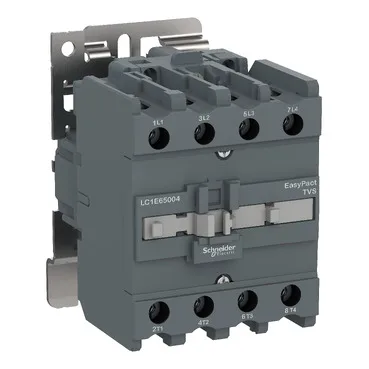
The contactor is built to EN/IEC 60947-4-1 and GB/T 14048.4 standards, so it meets the common panel and machine-build compliance requirements across Europe and China.
The 80 A AC-1 rating is the thermal current (Ith) for resistive loads — think heater banks, lighting, or transformer primaries. For motor loads you would need the AC-3 rating, which is not listed here; this part is specified for resistive duty. The 415 V 50 Hz control coil is a wide-range AC type, with operational limits of 0.7 to 1.25 Uc and drop-out at 0.3 to 0.6 Uc, so it holds in on a stiff supply but drops cleanly on undervoltage. The 4 NO pole configuration means all four poles are normally open, which is the standard for line-side switching. Mechanical durability is 5 million cycles, and electrical durability is 350,000 cycles under AC-1 duty. That puts it in the range for frequent switching in process control or HVAC cycling. The maximum operating rate is 1200 cycles per hour at 60 °C, so it can keep pace with a fast-cycling line.
The dimensions are 127 mm high, 85 mm wide, and 125 mm deep, so it occupies a standard contactor footprint. Power circuit terminals accept 2.5 to 25 mm² solid or flexible wire with cable ends; control circuit terminals take 1 to 4 mm². Tightening torque is 5 N·m on the power side and 1.2 N·m on the control side — a torque driver is needed for the power connections. The IP2X finger protection means it is safe for open-panel use but not washdown-rated.
It also meets IEC 60695-2-1 for glow-wire fire resistance at 850 °C and has TH protective treatment per IEC 60068-2-30 for humid environments. These cover the typical compliance documentation a quality or controls engineer would need for a panel build or machine certification.