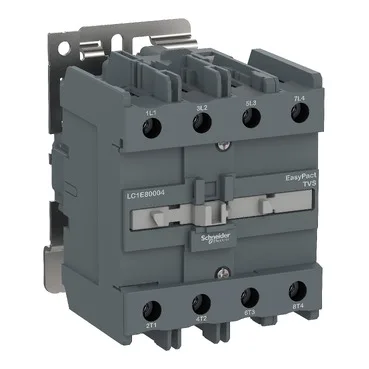
The contactor is configured with 4 normally open (NO) main poles and no built-in auxiliary contacts, so plan on adding a separate auxiliary block if you need feedback or interlocking.
The coil is a wide-range AC type, specified at 220 V AC 50 Hz. Pull-in power is 200 VA at 50 Hz (cos φ 0.75 at 20 °C), and steady-state heat dissipation in the control circuit runs 6 to 10 W. The coil holds in reliably from 0.7 to 1.25 Uc across -5 to 55 °C, and drops out between 0.3 and 0.6 Uc. Opening time is 6 to 20 ms; closing time is 20 to 35 ms. These timing windows matter if you're sequencing contactors in a transfer scheme — the spread is wide enough that you can't rely on millisecond-level coordination without external timing.
Mounts on either a plate or a DIN rail. Power circuit terminals accept screw-clamp connections from 4 to 50 mm² (flexible with cable end) or 4 to 50 mm² solid, with a tightening torque of 12 N·m. Control circuit terminals take 1 to 4 mm² at 1.2 N·m. The IP20 finger-safe enclosure is standard for panel-mount contactors; no washdown rating here, so keep it inside the cabinet.
The contactor also carries a TH protective treatment per IEC 60068-2-30 for damp-heat environments. Associated fuse rating for type 1 coordination is 160 A gG at ≤690 V.
Durability and operating limits
Mechanical durability is rated at 3 million cycles; electrical durability under AC-1 is 350,000 cycles. Maximum operating rate is 1200 cycles per hour at 60 °C. Vibration resistance is 1.5 Gn (contactor open) and 3 Gn (closed) over 5 to 300 Hz; shock resistance is 6 Gn for 11 ms (open) and 7 Gn for 11 ms (closed). These figures are solid for general industrial panel duty but not for high-vibration mobile equipment.