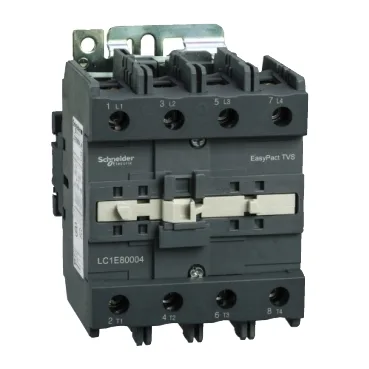
The LC1E80008M7IN is officially obsolete per Schneider Electric's lifecycle status. This is not a current-production part — it is a last-time-buy candidate now sourced through surplus and independent channels. Any substitution must be validated against the original application's ratings — particularly the 110 A AC-1 resistive load curve and the 4P (4NO) pole configuration.
This is a 4-pole (4NO) contactor rated 110 A in utilisation category AC-1 at ≤415 V, meaning it is designed for resistive loads — heaters, lighting banks, or non-inductive circuits where inrush is minimal. The AC-1 rating is the thermal current carrying capacity; do not apply this contactor to motor starting (AC-3) or inductive loads without derating, as the switching duty differs significantly. The coil voltage is 220 V (likely 220 V AC 50/60 Hz given the Easy TeSys range). The contactor carries EN/IEC 60947-4-1 and GB/T 14048.4 certifications, which cover contactors and motor-starters. IP2X finger protection means the enclosure prevents access to live parts with a 12 mm probe — standard for panel-mounted gear, not for washdown environments. Mounts on either a plate or a DIN rail. The 120 mm depth, 95 mm width, and 127 mm height fit standard control panel layouts, but the 4-pole width is wider than a typical 3-pole contactor — verify panel cut-out or rail space before committing.
The Easy TeSys Control range is Schneider's economy contactor series, typically specified for resistive load switching in distribution panels, HVAC control, lighting contactor panels, and industrial oven control. The 110 A rating suits moderate-power resistive circuits; the 4-pole configuration allows switching of three-phase plus neutral or dual independent circuits.
Standards & Environmental Ratings
Compliant with EN/IEC 60947-1 (general rules), 60947-4-1 (contactors and starters), and 60947-5-1 (control circuit devices). Also certified to Chinese GB/T equivalents. Mechanical robustness tested to 1.5 Gn vibration (open contacts) and 3 Gn (closed), plus shock resistance of 6 Gn (open) and 7 Gn (closed) for 11 ms — sufficient for general industrial panels but not for high-shock mobile equipment.