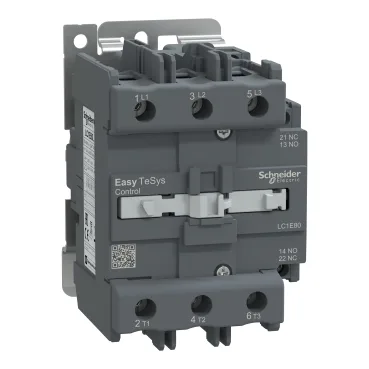
Its headline rating is 80 A in AC-3 utilisation category at up to 440 V, which means it handles the inrush and running current of a motor load up to that current — the AC-3 rating is the one that governs real motor-switching duty, not the higher AC-1 resistive rating. The coil is 240 V AC, so it pulls in on a standard control transformer secondary.
The utilisation categories tell you what loads this contactor can handle: AC-3 for squirrel-cage motors (starting and switching off during running), AC-3e for high-efficiency motors with higher inrush, and AC-1 for resistive loads like heaters. The non-overlap time of 1.5 ms on both energisation and de-energisation, guaranteed between NC and NO contacts, matters for safety circuits where you need to ensure the NC and NO poles never close simultaneously during transition. That timing is built into the contactor design, not something you add externally.
This contactor carries approvals against EN/IEC 60947-1, 60947-4-1, and 60947-5-1, plus the Chinese GB/T equivalents. It also meets EN/IEC 60335-1 Clause 30.2 and EN/IEC 60335-2-40 Annex JJ for appliance and heat-pump applications. The IP degree of protection is IP2X per IEC 60529 — finger-safe from the front, but not sealed against dust or water. In a clean, dry panel that's fine; for washdown environments you'd need an additional enclosure.