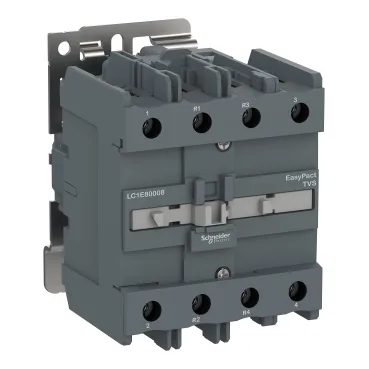
Its headline rating is 125 A at ≤440 V AC in AC-1 utilisation category — that's the current it can make and break in resistive circuits like heaters or lighting banks, not motor loads. The coil is 220 V AC at 50 Hz, wide-range type, with a drop-out threshold of 0.3 to 0.6 Uc and pick-up at 0.7 to 1.25 Uc across the -5 to 55 °C operating band.
The 125 A AC-1 rating governs the real-world resistive switching capacity. For motor duty (AC-3), you'd need to derate significantly — this contactor is not specified for AC-3, so if your BOM calls for motor switching, this isn't the right pick. The 4-pole configuration gives 2 NO + 2 NC main poles, which is useful for three-phase plus neutral or dual-load switching. Breaking capacity is 760 A at 440 V, and making capacity is 950 A at 440 V AC — both per IEC 60947. That's the short-circuit performance the contactor can handle once, not a continuous rating. The associated fuse recommendation is 160 A gG at ≤690 V for type 1 coordination, so upstream protection should be sized accordingly.
Power terminals accept up to 50 mm² cable (solid or flexible with ferrule), and control terminals take 1 to 4 mm². Tightening torque is 12 N.m on the power side and 1.2 N.m on control.
Certified to EN/IEC 60947-1, 60947-4-1, and 60947-5-1, plus the Chinese GB/T equivalents. Protective treatment is TH conforming to IEC 60068-2-30, meaning it's treated against tropical humidity — relevant if the panel sees condensation cycles.