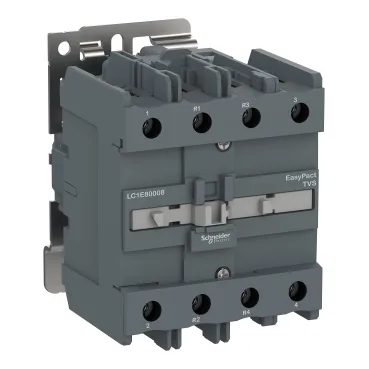
The 415 V AC 50 Hz coil is a wide-range AC type, meaning it pulls in reliably across a band of control voltages, not just a single tap. That covers the main power switching standard (60947-4-1) and the control-circuit standard (60947-5-1), so it fits panels destined for European or Chinese-certified machinery.
The 125 A AC-1 rating is the headline number, but note it is at ≤55 °C and ≤440 V — the AC-1 category means resistive load, not motor starting. For motor duty (AC-3) you would need to derate significantly; this contactor is not specified for AC-3. The 4-pole arrangement is 2 NO + 2 NC, giving you both normally-open and normally-closed power poles, which is useful for reversing or two-speed circuits where one set of poles breaks before the other makes. Mechanical durability is rated at 3,000,000 cycles, and electrical durability at 350,000 cycles under AC-1. That is a solid service life for a resistive-load contactor that cycles a few times per hour. The maximum operating rate is 1,200 cycles per hour at 60 °C, so it can keep pace with a fast-cycling oven or packaging line heater bank. The control circuit dissipates 6 to 10 W and has an inrush of 200 VA at 50 Hz (cos φ 0.75). That matters for transformer sizing in the control panel — a 200 VA inrush spike means the control transformer should be rated to handle that surge without dropping the coil voltage below the 0.7 Uc operational limit. Mounts on plate or DIN rail; the screw-clamp power terminals accept up to 50 mm² cable, which is what you would expect for a 125 A circuit.