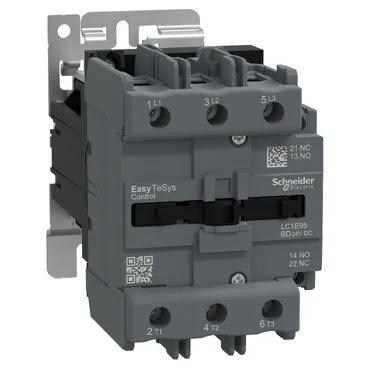
The Schneider Electric LC1E95BD is a 3-pole contactor from the Easy TeSys Control range, rated 95 A in AC-3 / AC-3e duty at ≤440 V with a 24 V DC coil. That AC-3 rating is what governs motor switching — it's the current the contactor can make and break across a typical squirrel-cage induction motor start, so 95 A lines up with a motor full-load current in that range. The coil holds at 24 V DC nominal; the guaranteed non-overlap time of 1.5 ms between NC and NO contacts on both energisation and de-energisation means the auxiliary contacts sequence cleanly for interlocking or safety circuits. It also carries an AC-1 rating for resistive loads, so it handles heater banks or lighting banks at the same current level, but the AC-3e rating is the one to watch for IEC motor-protection coordination — it's the enhanced version of AC-3 with tighter making-capacity requirements. The 24 V DC coil is a common control voltage in modern PLC-driven panels; just confirm your DC supply can deliver the inrush without dipping below the dropout threshold.
Mounts on DIN rail or a backplate — the 85 mm width and 126 mm depth keep it within a standard 8-module DIN footprint. The operating ambient range is -5 to 55 °C, so if it's going into a non-ventilated panel near a heat source, check the thermal curve; storage range extends to -60 to 80 °C. Altitude derating kicks in above 3000 m — no change needed for most installations. The protective treatment is TH conforming to IEC 60068-2-30, which means it's tested for tropical humid conditions — condensation and cyclic humidity won't cause creepage failures. That's a useful detail if the panel lives in a non-conditioned space or near a washdown zone (even though the contactor itself isn't IP-rated for water ingress).
The 850 °C glow-wire test per IEC 60695-2-1 means the thermoplastic body won't propagate a flame under fault conditions. Vibration resistance is 3 Gn closed (5 to 300 Hz) and 1.5 Gn open; shock resistance is 7 Gn closed, 5 Gn open — solid for machinery mounted on a frame or conveyor line. That means the BOM line stays stable, and the factory supports it with documentation and spares. No cross-reference needed for obsolescence; it's a straight order-code item.