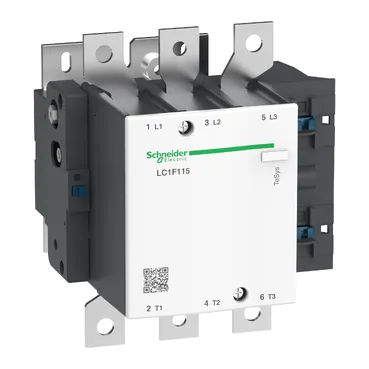
The LC1F115X6 is a TeSys F three-pole contactor from Schneider Electric, rated for motor control and resistive loads. Its headline AC-3 rating is 115 A at ≤440 V, which translates to a 55 kW motor at 380–400 V AC — the figure a panel builder uses to size the contactor for a given motor nameplate. The 55 kW at 400 V is the most common voltage band for European and Asian 400 V three-phase systems; the same contactor also supports 59 kW at 415 V and 80 kW at 660–690 V, so it covers multiple regional supply voltages without a frame change.
Ratings and application context
The utilisation categories cover AC-1 (resistive loads), AC-3 (squirrel-cage motor starting/running), and AC-4 (plugging, inching). The AC-3 rating is the one that governs motor switching: 115 A at ≤440 V, with a rated breaking capacity of 920 A conforming to IEC 60947-4-1. That breaking capacity tells you the contactor can safely interrupt a locked-rotor fault without welding its main poles — a critical parameter for any motor branch circuit. Mechanical durability is listed at 10 Mcycles, which is typical for a TeSys F frame contactor sized for heavy-duty cycling. Heat dissipation runs 12–16 W total, with 15 W per pole in AC-1 and 5 W per pole in AC-3 — so the thermal load inside the enclosure is modest, but the panel designer should still account for it if the contactor is grouped with other heat sources. The control circuit is AC 60 Hz with a rated voltage of 600 V AC, 40–400 Hz. Pick-up is 0.85–1.1 Uc at 55 °C; drop-out is 0.35–0.55 Uc. Inrush power is 660 VA at 60 Hz, hold-in is 55 VA. That inrush matters for transformer sizing in the control panel — a 660 VA surge on a small control transformer can pull the rail voltage below the dropout threshold of other coils on the same circuit. The closing time is 23–35 ms and opening time 5–15 ms.
The LC1F115X6 carries approvals to IEC 60947-1, IEC 60947-4-1, EN 60947-1, EN 60947-4-1, and JIS C8201-4-1. Rated insulation voltage is 1000 V per IEC 60947-4-1 and 1500 V per VDE 0110 group C. Overvoltage category III. Protective treatment is TH (tropicalisation for humid environments). The front face carries IP2X protection with shrouds per IEC 60529 and VDE 0106 — finger-safe from the front but not sealed against dust ingress.
Mounting is plate-mount (not DIN rail), so the panel designer needs to allocate bolt-down space. Dimensions are 6.4 in wide by 6.4 in tall by 6.7 in deep (163.3 × 162 × 171 mm). Power circuit connections accept bar (2 × 20 × 3 mm), ring terminals, or bolted connection up to 95 mm². Control circuit wiring uses screw clamp terminals accepting 1–4 mm² flexible or solid. Tightening torque is 10 N·m for the power circuit and 1.2 N·m for the control circuit.