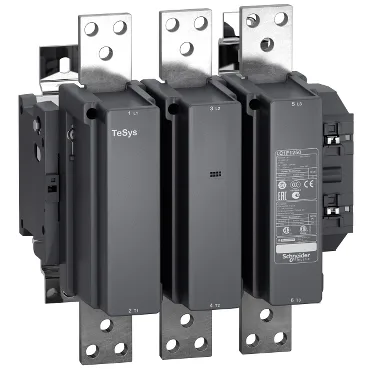
The Schneider Electric LC1F1250FD is a TeSys F series 3-pole contactor rated for 1260 A in AC-1 duty (resistive loads) at up to 690 V AC 50/60 Hz, with a 110 V DC standard control coil. It is built to IEC 60947-4-1 and EN 60947-4-1, covering motor starting and resistive switching in industrial power panels.
The 1260 A AC-1 rating governs resistive loads — heaters, furnaces, lighting banks. For motor duty (AC-3), the contactor carries a lower rating not listed here; verify the specific motor FLA against the AC-3 curve if switching induction motors. The 110 V DC coil pulls 1600 W inrush at 20 °C, then holds at 9 W — the control circuit must supply that inrush without voltage sag below 0.85 Uc (93.5 V DC) at 55 °C. Drop-out occurs between 0.2 and 0.35 Uc (22 to 38.5 V DC). Short-time withstand (Icw) is 8000 A for 10 s, 5200 A for 30 s, 3000 A for 3 min — this defines coordination with upstream protective devices. The associated fuse recommendation is 1000 A gG at ≤ 440 V. Rated breaking capacity is 1890 A per IEC 60947-4-1. Insulation voltage is 1000 V (IEC) / 1500 V (VDE group C), with an 8 kV impulse withstand. Mounting is plate-style (not DIN rail), with power circuit bolted connections using 100 x 5 mm bar. Power circuit torque is 58 N.m — substantial, requiring a torque wrench. Control circuit terminals are screw clamp, accepting 1 to 4 mm² flexible or solid. The contactor dissipates 9 W holding power and 120 W per pole in AC-1 service.
Deployment Context
This is a plate-mounted, bolted-connection contactor sized for large power panels — think main switchgear, large resistive banks, or heavy industrial furnace control. The 255 mm depth, 309 mm width, and 338 mm height require generous enclosure space and a lifting plan for installation. Operating altitude is 3000 m without derating; ambient range is -5 to 40 °C. Protective treatment is TH (tropicalized) for humid environments.