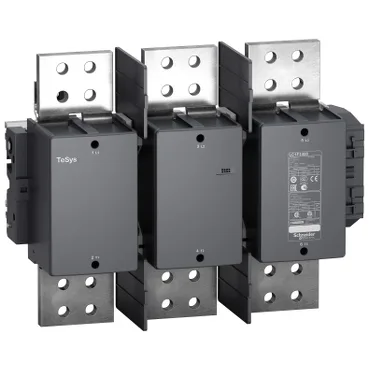
Its rated operational current is 1400 A at 40 °C (conventional free-air thermal current Ith also 1400 A), so it handles high-current heater banks, large lighting arrays, or furnace elements without derating at that ambient. The control circuit runs on 440 V AC at 40–400 Hz, with an inrush of 2200 VA and a hold-in draw of 36 VA. Coil pickup is guaranteed between 0.85 and 1.1 Uc, and dropout between 0.3 and 0.5 Uc — that 0.3 floor means it releases reliably even if the control voltage sags badly.
Rated breaking capacity is 2100 A per IEC 60947-4-1, and the short-time withstand current Icw holds 8000 A for 10 seconds — that tells you the contactor can ride through a fault long enough for an upstream breaker to clear, assuming the coordination study supports it. Power dissipation per pole is 150 W in AC-1 duty, so at full load the contactor dumps about 450 W total into the enclosure. That matters for panel thermal management — if you're packing this into a tight cabinet, you need to vent or derate. The rated insulation voltage Ui is 1000 V per IEC 60947-4-1, and impulse withstand Uimp is 8 kV. Overvoltage category III means it's designed for fixed-installation distribution boards, not for surge-prone outdoor feeders.
Mounting is plate-mount only — no DIN-rail clip on this frame size. The power circuit uses bar connections with a busbar cross-section up to 100 x 5 mm, and the tightening torque is a substantial 58 N.m on the power terminals. Control wiring uses screw-clamp terminals accepting 1 to 4 mm² flexible or solid.
The LC1F1400R7 carries approvals to IEC 60947-1, EN 60947-1, JIS C8201-4-1, IEC 60947-4-1, EN 60947-4-1, UL 60947-4-1, and CSA C22.2 No 60947-4-1. That covers most global industrial installations — IEC markets, North American UL/CSA jobs, and Japanese JIS sites. Protective treatment is TH (tropicalized) for humid environments, and operating altitude goes to 3000 m without derating. Storage temperature range is -60 to 80 °C.