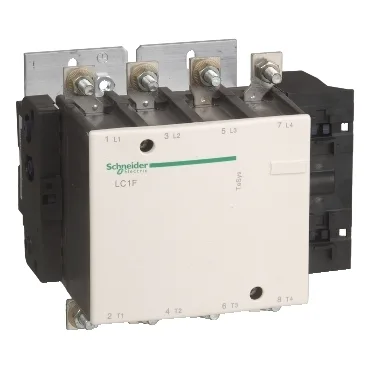
The Schneider Electric LC1F1504G7 is a TeSys F 4-pole contactor rated 250 A in AC-1 utilisation category (resistive load) at ≤ 440 V, 40 °C ambient. That 250 A figure governs the continuous current the main poles can carry when switching resistive loads like heaters or lighting banks — not motor starting. For motor duty (AC-3), the contactor would derate; the spec table lists AC-1 only, so this unit is sized for resistive switching, not inductive motor loads. The 120 V AC control coil (40–400 Hz) pulls 770 VA inrush, holds at 8.1 VA. Coil drop-out range is 0.2–0.55 Uc, so it releases reliably on a sagging line. Mounting is plate-only — no DIN-rail clip. The 171 mm depth and 200.5 mm width mean it occupies a panel footprint comparable to a small frame breaker; plan for bolted power connections (bar or lug, up to 120 mm² cable). Control wiring uses screw-clamp terminals accepting 1–4 mm² flexible or solid.
The contactor carries approvals to EN 60947-1, IEC 60947-4-1, and JIS C8201-4-1, with rated insulation voltage 1000 V per IEC 60947-4-1 and 1500 V per VDE 0110 group C. Impulse withstand is 8 kV.
Integration notes
Plate-mount the contactor on a flat panel surface; the 170 mm height and 200.5 mm width leave clearance for power busbars (25 x 3 mm bar or ring terminals). Tighten power circuit connections to 18 N·m, control circuit to 1.2 N·m. The IP2X front face with shrouds meets IEC 60529 and VDE 0106 for finger protection — no additional guarding needed in a closed panel. Heat dissipation runs 5.9–7.2 W total; each pole dissipates 22 W in AC-1 duty. At 55 °C ambient, the maximum operating rate is 2400 cycles per hour. Mechanical durability is 10 million cycles. For fuse protection, use 160 A aM or 250 A gG at ≤ 440 V.