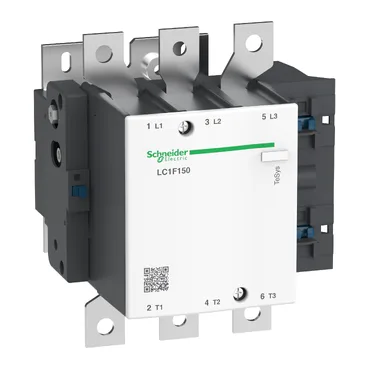
It carries a rated operational current (Ie) of 250 A at ≤440 V in AC-3 duty, which means it handles the inrush and running current of squirrel-cage motors up to that rating — not just the resistive heating curve. Motor power ratings span the common voltage bands: 75 kW at 380–400 V AC, 80 kW at 415 V and 440 V, 90 kW at 500 V, and 100 kW at 660–690 V AC, all in AC-3. For the higher-stress AC-4 duty (plugging, inching), it is rated 22 kW at 400 V. That spread tells you the part was sized for European and Asian voltage standards — 400 V is the sweet spot.
Mechanical durability is 10 million cycles, so the wear life is in the bearings and springs, not the contacts, for typical motor-switching duty. Control circuit voltage is 250 V DC, with an operational range of 0.85 to 1.1 Uc at 55 °C and a drop-out range of 0.15 to 0.2 Uc. Heat dissipation is 4.5 W holding, with an inrush of 560 W at 20 °C. The rated insulation voltage (Ui) is 1000 V per IEC 60947-4-1 and 1500 V per VDE 0110 group C. Rated breaking capacity is 1200 A per IEC 60947-4-1. The front face with shrouds provides IP2X finger protection per IEC 60529 and VDE 0106, so it meets the basic touch-safety requirement for open panel mounting.
Mounting is plate-style — not DIN-rail snap-on — so it bolts directly to a backplate or mounting rail in the enclosure. Dimensions are 6.7 in (171 mm) deep, 6.4 in (163.5 mm) wide, and 6.7 in (170 mm) tall, which is a standard TeSys F footprint. Power circuit connections are bar-type (2 x 25 x 3 mm), lugs, or bolted, accepting up to 120 mm² cable. Control circuit terminals are screw-clamp, accepting 1 to 4 mm² flexible or solid wire. Tightening torque for the power circuit is 159.3 lbf·in (18 N·m); the control circuit is 10.6 lbf·in (1.2 N·m). The average impedance per pole is 0.35 mOhm at 250 A.