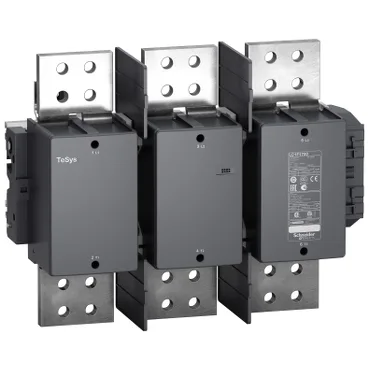
That 1700 A is the conventional free-air thermal current (Ith) at 40 °C — the number that governs continuous current handling in a panel. The 250 VDC control coil pulls 2100 W inrush at 20 °C, then holds at 10 W. Closing time runs 50 to 60 ms; opening takes 45 to 60 ms.
Lifecycle reality — end of life
This part is marked end-of-life (EOL). If you have it on a BOM for a new build, you need to freeze that line now or identify a replacement before the last-time-buy window closes.
Rated breaking capacity is 2550 A per IEC 60947-4-1 — that is the current it can interrupt without welding its main poles. Short-time withstand (Icw) is 10 kA for 10 seconds at 40 °C, then derates through 7.5 kA for 30 s, 5.5 kA for 1 min, 4.2 kA for 3 min, and 3 kA for 10 min. That tells you how long it can ride through a fault before the upstream protection must clear. Insulation voltage (Ui) is 1000 V per IEC/UL, 1500 V per VDE 0110 group C. Impulse withstand (Uimp) is 8 kV. The associated upstream fuse recommendation is 1600 A gG at ≤ 440 V.
Compliant with EN 60947-4-1, IEC 60947-1, IEC 60947-4-1, JIS C8201-4-1, EN 60947-1, UL 60947-4-1, and CSA C22.2 No 60947-4-1. Overvoltage category III. Protective treatment TH for tropical environments.
Plate-mounted — no DIN-rail clip on this frame size. Power circuit terminates via bolted connection or bar (busbar cross-section up to 100 x 5 mm). Control circuit uses screw clamp terminals, accepting 1 to 4 mm² flexible or solid wire (with or without ferrule). Tightening torque: 1.2 N·m on the control circuit, 58 N·m on the power circuit. Dimensions: 438 mm wide, 332 mm high, 238.6 mm deep.