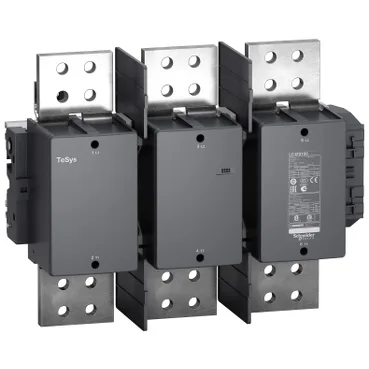
What the 2100 A AC-1 rating means for fit
The LC1F2100ED is a 3-pole contactor from the TeSys F series, rated 2100 A in AC-1 utilisation category (resistive loads) at 40 °C. That 2100 A figure governs the continuous current the main poles can carry when switching resistive heating banks, furnace elements, or similar loads where the current waveform stays near sinusoidal. For motor duty (AC-3 or AC-4), the rated operational current will be lower — the AC-1 number alone does not size a motor starter. The conventional free-air thermal current Ith matches at 2100 A, confirming the pole stack is rated for that continuous current in open mounting. Control is 48 V DC standard, with a pickup range of 0.85 to 1.1 Uc at 55 °C and a dropout band of 0.2 to 0.35 Uc. That dropout threshold is tight — below about 9.6 V the armature releases, which matters for brownout ride-through on a DC bus. Hold-in power settles to 10 W at 20 °C, and the inrush spike hits 2100 W at the same temperature, so the DC supply needs headroom for the pull-in transient.
Standards and approvals — the compliance baseline
The contactor carries certification to EN 60947-4-1, IEC 60947-4-1, UL 60947-4-1, and CSA C22.2 No 60947-4-1, plus JIS C8201-4-1. That IEC/UL/CSA triad covers most global panel builds — a panel destined for a North American line needs the UL/CSA listing, while European machinery spec sheets reference the EN/IEC editions. Rated insulation voltage Ui is 1000 V per IEC 60947-4-1 and 1500 V per VDE 0110 Group C; impulse withstand Uimp is 8 kV, so the contactor can live in a 480 V or 690 V distribution without additional series insulation.
Short-time withstand and breaking — selectivity data
Rated short-time withstand current Icw is 10 kA for 10 s at 40 °C, stepping down to 3 kA for 3 min and 3000 A for 10 min. That Icw curve tells the protection engineer how long the contactor can hold during a downstream fault before the upstream breaker clears — useful for coordination studies in a 480 V switchboard. Rated breaking capacity is 3150 A per IEC 60947-4-1, which covers most motor-starting inrush scenarios but is not a short-circuit rating; the associated fuse recommendation is 2000 A gG at ≤ 440 V.
Mounting and termination — panel integration notes
Mounting is plate-style — no DIN rail adapter. The contactor measures 438 mm wide by 332 mm high by 238.6 mm deep, so it occupies a substantial footprint on the backplate. Power circuit termination is bar or bolted connection, accepting busbar cross-sections up to 100 x 5 mm with up to four cables. Control circuit wiring uses screw-clamp terminals accepting 1 to 4 mm² flexible or solid, with or without ferrules. Tightening torque for the power circuit is 58 N·m — that is high enough to need a torque wrench on the busbar bolts, not a screwdriver.