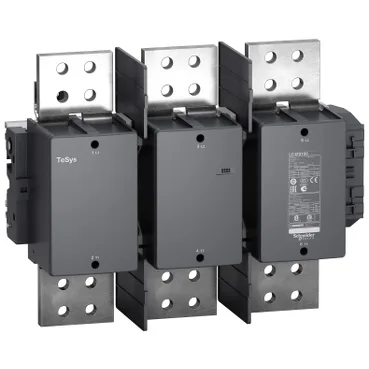
The 440 V DC coil means this is a DC-operated unit, so it pulls in and holds on a DC control voltage, which avoids the hum and dropout issues of an AC coil in noisy panels. Plate-mount only — no DIN rail here, so budget for a backplate and the 58 N·m power-circuit torque spec when terminating the busbars.
That's a lot of copper — the power circuit uses bar connections, 4 cables per phase, busbar cross-section 100 x 5 mm. The associated fuse rating is 2000 A gG at ≤ 440 V, so the upstream protection needs to be sized accordingly. Rated breaking capacity is 3150 A per IEC 60947-4-1, and short-time withstand current hits 10 kA for 10 seconds — enough to ride through a downstream fault without welding the contacts. The DC coil has a pickup range of 0.85 to 1.1 Uc at 55 °C, and drops out between 0.2 and 0.35 Uc. Hold-in power is just 10 W at 20 °C, so the coil doesn't cook the panel. Operating time is 50-60 ms closing, 45-60 ms opening — fast enough for most switching sequences, but not a high-speed transfer switch. Maximum operating rate is 600 cycles per hour at 55 °C, which covers frequent cycling in resistance heating or furnace control.
Plate mount only — dimensions are 438 mm wide, 332 mm high, 238.6 mm deep. Plan for a backplate that accommodates the 100 x 5 mm busbar cross-section and 58 N·m torque spec.
Certified to EN 60947-4-1, IEC 60947-4-1, UL 60947-4-1, and CSA C22.2 No 60947-4-1 — so it's accepted in North American and European installations. Rated insulation voltage is 1000 V per IEC and UL, 1500 V per VDE 0110 group C. Impulse withstand voltage is 8 kV, overvoltage category III. Protective treatment is TH (tropicalized) for humid environments.