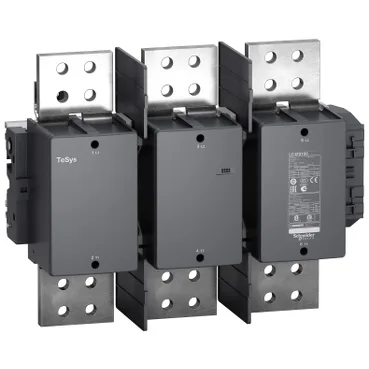
The Schneider Electric LC1F2100UD is a 3-pole contactor from the TeSys F range, rated for 2100 A in AC-1 duty (resistive loads) at ≤40 °C. The 250 V DC coil pulls in at 0.85 to 1.1 times nominal and drops out between 0.2 and 0.35 times nominal. Plate-mounted, sized for 438 mm wide by 332 mm tall, depth 238.6 mm.
The conventional free-air thermal current (Ith) is also 2100 A at 40 °C — same as the AC-1 operational current, so the contactor is thermally rated for continuous resistive load at that level. The short-time withstand current (Icw) is 10,000 A for 10 seconds, 7500 A for 30 seconds, 5500 A for 1 minute, 4200 A for 3 minutes, and 3000 A for 10 minutes — all at 40 °C. That tells you the contactor can ride through a fault for long enough for an upstream breaker to clear, but the coordination study should check that the upstream protective device's let-through energy stays under these limits. Associated fuse rating is 2000 A gG at ≤440 V — use that as the maximum fuse size for short-circuit protection.
The LC1F2100UD carries approvals under IEC 60947-4-1, EN 60947-4-1, UL 60947-4-1, CSA C22.2 No 60947-4-1, and JIS C8201-4-1. The rated insulation voltage (Ui) is 1000 V per IEC/UL, and 1500 V per VDE 0110 group C. Impulse withstand voltage (Uimp) is 8 kV. Overvoltage category III. These are the standards that govern its use in industrial control panels — UL listing matters for North American installations, IEC for European. The protective treatment is TH (tropicalized), which means it's treated for humidity and fungus resistance — relevant if the panel lives in a non-conditioned environment.
Mounting is plate-mount — no DIN rail clip, so you need a backplate with drilled holes matching the 438 mm x 332 mm footprint. Power circuit connections are bolted bars; the bar cross-section is 100 x 5 mm, and it accepts up to 4 cables. Control circuit connections are screw-clamp terminals accepting 1 to 4 mm² flexible or solid (with or without ferrules). Tightening torque: 58 N.m for the power circuit, 1.2 N.m for the control circuit. Heat dissipation is 10 W total, with 200 W per pole in AC-1 duty — that's significant heat; the enclosure must have adequate ventilation or forced cooling if the contactor is running near its rated current continuously.