What the 2100 A AC-1 Rating Means for Your Load
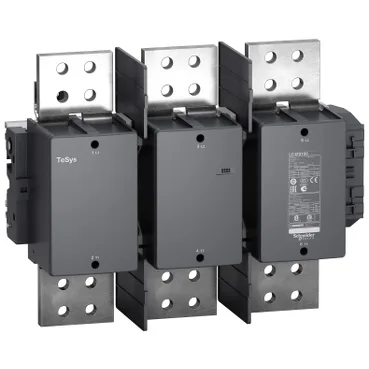
The LC1F2100W7 is a 3-pole contactor from the TeSys F range, rated for 2100 A in AC-1 utilisation category at 40 °C — that is the conventional free-air thermal current (Ith) as well, so it is sized for purely resistive loads such as large furnace banks, electrolytic cells, or heavy-duty heater circuits where inrush is minimal and the power factor stays near unity. The AC-1 rating governs the continuous current the main poles can carry without exceeding a 200 W per-pole dissipation, provided the ambient stays below 40 °C and the mounting plate allows free convection across the 438 mm wide, 332 mm tall body. The control circuit is AC-powered at 265-277 V, 40-400 Hz, drawing 2200 VA inrush and 36 VA sealed. The operating limits are 0.85 to 1.1 times Uc for pick-up and 0.3 to 0.5 Uc for drop-out — a wide enough band to tolerate a sagging auxiliary transformer on a motor control centre bus, provided the control transformer is sized for the inrush. Opening time runs 100 to 170 ms; closing time is faster at 40 to 75 ms, so the contactor does not contribute significant delay in a protection chain that already has a breaker clearing in a few cycles.
Integration Constraints for Panel Builders
Mounting is plate-only — no DIN-rail clip on this frame size. The power circuit terminates via bolted busbar connections accepting up to four bars of 100 x 5 mm cross-section; the control circuit uses screw-clamp terminals accepting 1 to 4 mm² solid or flexible (with or without ferrules). Tightening torque is 58 N.m on the power side and 1.2 N.m on the control side — a torque wrench is mandatory on the power lugs; the control terminals are standard screwdriver torque. The 238.6 mm depth means the contactor projects well forward of the mounting plate; allow clearance for the arc chutes and the busbar bend radius behind the panel door.
Fault Withstand and Coordination
The LC1F2100W7 is rated for a short-time withstand current (Icw) of 10,000 A for 10 seconds at 40 °C, stepping down to 3,000 A for 10 minutes — this is the thermal limit the poles can survive without welding under a sustained fault, provided the upstream protective device clears before the Icw time expires. The associated fuse recommendation is 2000 A gG at ≤ 440 V. The rated breaking capacity is 3150 A per IEC 60947-4-1, and the impulse withstand voltage is 8 kV (overvoltage category III). For a site electrical engineer coordinating selectivity on a 400 V switchboard, these numbers define the fault-handling envelope: the contactor can ride through a moderate fault for several seconds, but the upstream fuse or breaker must be selected to keep the let-through energy below the Icw curve.
Environmental and Compliance Profile
The contactor carries TH protective treatment (tropicalisation) for humid environments. Operating temperature range is -5 to 40 °C; storage range is -60 to 80 °C. Altitude rating is 3000 m without derating. Standards compliance includes IEC 60947-4-1, IEC 60947-1, EN 60947-1, JIS C8201-4-1, UL 60947-4-1, and CSA C22.2 No 60947-4-1 — so it is accepted in European, North American, and Japanese installations. The rated insulation voltage is 1000 V per IEC and UL, and 1500 V per VDE 0110 group C. These approvals are the authority signals a procurement or compliance engineer needs to sign off on the part for a global project.