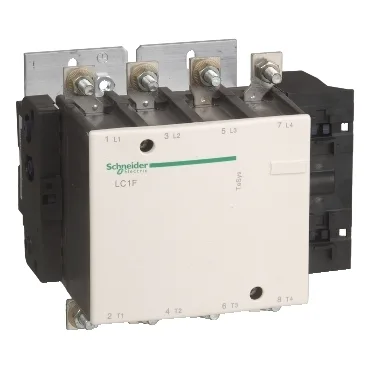
It carries a rated operational current of 315 A at ≤ 440 V AC and a rated operational voltage up to 690 V AC 50/60 Hz. The four normally-open power poles give you a straightforward make/break on each phase plus a spare, which matters when you're wiring a three-phase resistive bank and want the fourth pole for neutral or an auxiliary load. The coil is 115 V AC, 40–400 Hz, with a hold-in consumption of 9.9 VA at 20 °C and an inrush of 1070 VA. That inrush spike is worth noting for transformer-coupled control circuits — make sure your control transformer can deliver the peak without dropping below 85 % of Uc, because the coil's operational limits are 0.85–1.1 Uc at 55 °C. Drop-out range is 0.2–0.55 Uc, so it releases reliably on a sagging control bus.
This contactor is designed for plate mounting, not DIN rail — you'll bolt it to a backplate or sub-panel. Dimensions are 197 mm high, 208.5 mm wide, 181 mm deep. The power circuit uses bar connections accepting a 32 x 4 mm busbar, or ring terminals up to 185 mm², or bolted lugs. Control wiring is via screw-clamp terminals accepting 1–4 mm² flexible or solid. Tightening torque is 1.2 N·m on the control side and a hefty 35 N·m on the power side — that's a big torque figure, so use a torque wrench and the right hex bit; under-torquing the power connection on a 315 A circuit creates a hot spot you don't want. Inside a panel that's fine; outdoors or in a washdown zone you'll need an enclosure around it.
The headline number is 315 A at ≤ 440 V in AC-1. AC-1 covers resistive loads — heaters, furnaces, lighting banks — where the current is nearly in phase with voltage and there's no inductive kick. If you're switching motors (AC-3 or AC-4 duty), this contactor is not rated for that; you'd need a different TeSys F variant with a higher AC-3 rating. The average impedance per pole is 0.32 mΩ at 315 A, 50 Hz, which translates to about 32 W of heat dissipation per pole in AC-1, and total heat dissipation of 8–9.8 W across the assembly. That's the heat you have to manage inside the enclosure — at 315 A continuous, even a few watts per pole adds up, so don't pack it tight without ventilation or a thermal calculation. That's a fast cycling rate — about 40 operations per minute — which suits applications like cyclic resistive load banks or rapid transfer switches.
The contactor is designed and tested to IEC 60947-1, IEC 60947-4-1, EN 60947-1, EN 60947-4-1, and JIS C8201-4-1. Rated insulation voltage is 1000 V per IEC 60947-4-1 and 1500 V per VDE 0110 Group C. Impulse withstand voltage is 8 kV, and overvoltage category is III — that's the category for fixed-installation distribution panels, not for plug-connected equipment. Protective treatment is TH, meaning it's tested for tropical heat and humidity conditions. Operating altitude goes to 3000 m without derating, which covers most high-altitude sites except extreme mining or mountain installations.