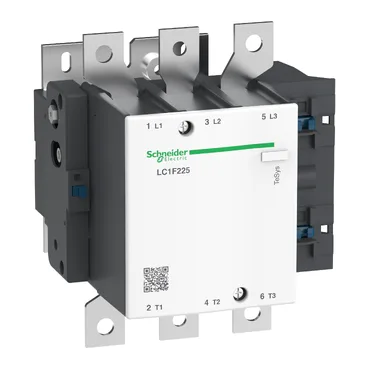
Its headline rating is 315 A at ≤440 V in AC-3 duty, which translates to 110 kW motor power at 380–400 V AC — the figure that decides whether it drives your pump, conveyor, or compressor. The control circuit is a 127–132 V AC 50 Hz coil, with an operational voltage range of 0.85–1.1 Uc and a drop-out range of 0.35–0.55 Uc. That means the coil holds in reliably down to about 108 V and drops out cleanly below about 46 V — important for brownout ride-through or undervoltage release coordination. The inrush power is 805 VA at 50 Hz, and hold-in consumption drops to 55 VA, so the control transformer must be sized for the inrush peak, not the steady-state draw. The rated insulation voltage is 1000 V per IEC 60947-4-1 and 1500 V per VDE 0110 group C, so it's suitable for 690 V line-to-line systems with adequate clearance.
If a direct drop-in replacement from the TeSys F family exists, it would need to be verified against the specific mounting footprint, coil voltage, and power ratings. The LC1F225G5 uses a plate-mounting support and bar-type power connections — any substitute must match the 168.5 mm width and 181 mm depth for panel layout compatibility.
The contactor is designed and tested to IEC 60947-1, EN 60947-4-1, IEC 60947-4-1, EN 60947-1, and JIS C8201-4-1. These standards cover low-voltage switchgear and controlgear — specifically part 4-1 for contactors and motor-starters. The protective treatment is TH, which indicates tropicalized humidity protection — suitable for warm, humid environments without condensation. Overvoltage category III means it is rated for fixed-installation distribution-level transients, not just downstream equipment. The associated fuse rating is 315 A gG or 250 A aM at ≤440 V — use these for short-circuit coordination rather than relying on the contactor's own breaking capacity alone.
Integration notes
Mounting is plate-based, not DIN rail — plan for bolt-down installation on a backplate or chassis. Power circuit connections use bar-type terminals accepting 32 x 4 mm bars or lugs up to 185 mm². Tightening torque for the power circuit is 309.8 lbf·in (35 N·m) — a torque wrench is required; under-torquing creates hot spots at full load. Control circuit terminals are screw-clamp, accepting 1–4 mm² flexible or solid wire, torqued to 10.6 lbf·in (1.2 N·m). Heat dissipation is 18–24 W total, with 32 W per pole in AC-1 and 16 W per pole in AC-3. For a panel with multiple contactors side by side, derating or forced ventilation may be needed above 40 °C ambient. The average impedance per pole is 0.32 mΩ at 315 A 50 Hz, which translates to about 0.1 V drop per pole at rated current — negligible for voltage drop calculations but relevant for heat buildup in dense cabinets.