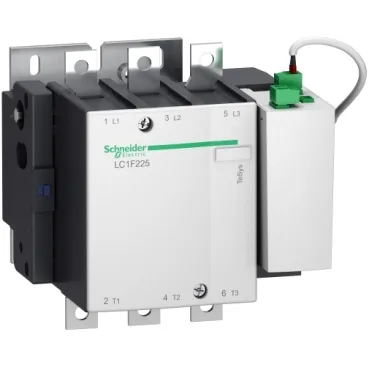
The control circuit accepts a wide range: 100...250 V AC 50/60 Hz or 100...380 V DC, with an electronic interface that is PLC-compatible at 24 V DC per IEC 61131-2 Type 2. This gives the compliance buyer a documented declaration of conformity for the panel.
Mounting is plate-based — the contactor is designed for bolted attachment to a backplate in the enclosure, not DIN-rail snap-on. Dimensions are 197 mm height, 168.5 mm width, and 181.5 mm depth. Power circuit connections accept bar (2 cables or busbar 32 x 4 mm), ring terminals (1 cable up to 185 mm²), or bolted connection. Tightening torque is 35 N·m on the power circuit and 0.6 N·m on the control circuit.
Rated operational current is 315 A in AC-3 at ≤440 V and 225 A at ≤55 °C in AC-3 — the lower figure at elevated ambient is the one to size against if the panel runs warm. Rated insulation voltage is 380 V per IEC 60947-4-1. The associated fuse rating is 315 A gG or 250 A aM at ≤440 V — use this for upstream short-circuit protection coordination. Operating time is 40...80 ms closing and 6...54 ms opening. Power dissipation per pole is 32 W in AC-1 and 16 W in AC-3; total heat dissipation is 2.2...5.5 W, which factors into enclosure thermal calculations. The control circuit is electronic, accepting both AC and DC. Operational voltage limits are 85...275 V AC 50/60 Hz and 85...418 V DC at 55 °C; drop-out occurs at 0...60 V AC and 0...45 V DC. Inrush power is 270...320 W or 280...310 VA at 20 °C; hold-in power is 2.5...4 W. The PLC input compatibility (24 V DC per IEC 61131-2 Type 2) means it can be driven directly from a PLC digital output without an interposing relay, with off-state at 0...5 V and on-state at 11...30 V. The average impedance is 0.32 mOhm at Ith 315 A, 50 Hz.