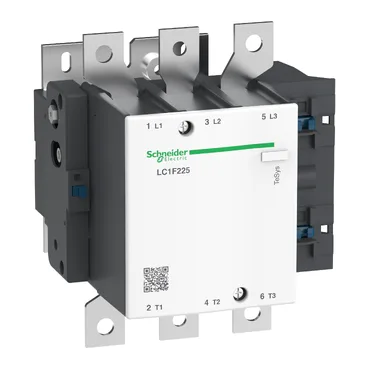
The Schneider Electric LC1F225Q6 is a TeSys F series 3-pole contactor rated for 315 A operational current in AC-3 duty (motor switching) at ≤ 440 V, with a 380 V AC 60 Hz control coil. It switches motor loads up to 110 kW at 380–400 V AC and 129 kW at 500 V, covering the common European and Asian line voltages. The 315 A AC-3 rating means it handles the inrush and breaking of squirrel-cage induction motors at that current — not just resistive loads — so it is sized for a 110 kW motor at 400 V, not a general-purpose 315 A switch.
Standards and approvals — what the ratings certify
The LC1F225Q6 is designed and tested to IEC 60947-4-1 and IEC 60947-1, the core standards for contactors and motor-starters. It also carries JIS C8201-4-1 and EN 60947-1/4-1 compliance, making it accepted in European, Japanese, and many other markets without re-certification. The rated insulation voltage is 1000 V per IEC 60947-4-1, overvoltage category III, so it is suitable for fixed-installation industrial panels with transient overvoltages up to that category. The IP20 front face with shrouds (per IEC 60529 and VDE 0106) means finger-safe when installed in an enclosure — no additional guarding needed on the front.
Mounting and integration — plate-mount, not DIN rail
Mounting is plate-only — no DIN-rail clip, so plan for a backplate or sub-panel with drilled/tapped holes. Dimensions are 197 mm high, 168.5 mm wide, 181 mm deep. Power connections are bolted bar or ring-terminal lugs accepting up to 185 mm² cable; control wiring is screw-clamp terminals accepting 1–4 mm² flexible or solid. Tightening torque is 35 N·m on the power circuit and 1.2 N·m on the control circuit — a torque wrench is needed for the power connections.
Heat dissipation is 18–24 W total, with 32 W per pole in AC-1 (resistive) and 16 W per pole in AC-3 (motor) duty. That is moderate for a contactor this size — expect some thermal rise in a sealed cabinet, but not enough to force a fan in most installations. The associated fuse recommendation is 315 A gG or 250 A aM at ≤ 440 V — coordinate your upstream protection accordingly.