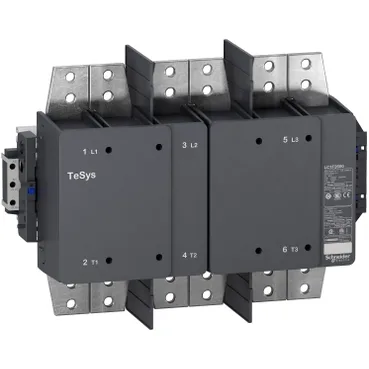
The 110 V AC control coil operates across 40-400 Hz and pulls 2500 VA inrush, holding at 45 VA. Mounts to a plate, not a DIN rail — at 519 mm wide and 382 mm tall, this is a panel-floor or backplate install, sized for the busbar connection (power circuit bar accepts up to 100 x 10 mm bus).
AC-1 at 2600 A is the headline number — this contactor is not for motor starting (that would be AC-3, which would be lower). The associated fuse recommendation is 2500 A gG at ≤440 V — size that accordingly. Coil hold-in voltage drops out between 0.3 and 0.5 Uc (33-55 V AC for a 110 V coil) — that's a wide dropout band, typical for large contactors, but means you need clean control power to avoid nuisance drop. Operating time is 40-80 ms close, 100-200 ms open — not a fast-switching device; sequence timing in a control scheme should account for that. Heat dissipation is 40 W total, but each pole dissipates 250 W under AC-1 load — that's 750 W total across three poles. The panel ventilation must handle that; the -5 to 40 °C operating ambient is the limit, and altitude derating starts above 3000 m.
Certified to EN 60947-4-1, IEC 60947-4-1, UL 60947-4-1, CSA C22.2 No 60947-4-1, and JIS C8201-4-1. Rated insulation voltage 1000 V, impulse withstand 8 kV, overvoltage category III. IP20 front face with shrouds per IEC 60529 and VDE 0106 — protected against finger contact from the front, but the terminals are live; panel door interlock is standard practice.
Integration notes
Plate mount only — no DIN-rail adapter. Control circuit screw terminals accept 1-4 mm² flexible or solid, one or two cables, with or without ferrule. Power circuit uses bar connection: three cables or busbar up to 100 x 10 mm. Tightening torque: control circuit 1.2 N·m, power circuit 58 N·m — that is a high torque; use a torque wrench and the correct hex bit. Storage temperature range -60 to 80 °C covers warehouse extremes.