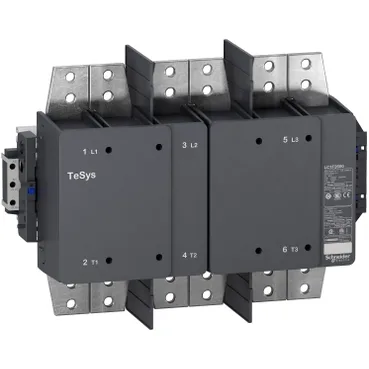
The Schneider Electric LC1F2600G7 is a 3-pole TeSys F contactor rated for 2600 A in AC-1 duty (resistive loads), with a 120 V AC control coil operating at 40–400 Hz. It is designed for heavy switching of resistive loads such as large heating banks or furnace elements, where the AC-1 rating governs the continuous current-carrying capacity without derating for motor inrush. The contactor carries a full slate of international approvals: EN 60947-4-1, IEC 60947-4-1, UL 60947-4-1, CSA C22.2 No 60947-4-1, and JIS C8201-4-1, making it acceptable for panels destined for North America, Europe, and Asia without additional re-certification.
The 2600 A AC-1 rating is the headline figure — it tells you the contactor can carry 2600 A continuously through resistive loads at up to 60 °C ambient. For motor loads (AC-3), the rating will be lower; this part is not sized for a motor starter without consulting the AC-3 derating curve. Short-time withstand current (Icw) is 12,000 A for 10 seconds at 40 °C, tapering to 4,000 A for 10 minutes. This matters for coordination with upstream protective devices — the contactor must be able to ride through a downstream fault until the breaker clears. The associated fuse recommendation is 2500 A gG at ≤ 440 V. Control circuit is AC only, 120 V at 40–400 Hz, with a pickup inrush of 2500 VA and a hold-in consumption of 45 VA. The coil dropout range is 0.3–0.5 Uc, so verify your control transformer sizing — the inrush can pull down a lightly loaded supply. Heat dissipation is 40 W total, with 250 W per pole in AC-1 service. That heat must be managed in the enclosure — plate mounting on a vertical surface with adequate airflow is assumed. The 0.1 mOhm average impedance at 2600 A 50 Hz gives a voltage drop of about 0.26 V per pole at full load.
This is a plate-mount contactor — no DIN rail. The dimensions are substantial: 519 mm wide, 382 mm high, 251 mm deep. Power connections are via busbar, accepting up to 100 x 10 mm cross-section, with a tightening torque of 58 N.m. Control wiring uses screw clamp terminals accepting 1–4 mm² flexible or solid. The IP20 front face with shrouds is sufficient for enclosed panel use but not for washdown environments.