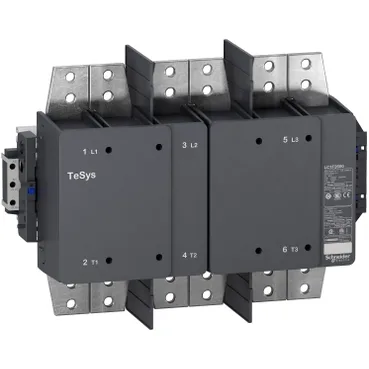
What the 2600 A AC-1 rating means for your panel
At 2600 A continuous, the 0.1 mOhm average impedance per pole (at 50 Hz) means about 250 W dissipation per pole, so 40 W total heat shed to the enclosure. That heat has to go somewhere — plate-mount it on a steel backplate with enough surface area, not DIN rail, and keep ambient under 40 °C. The 3 NO power poles handle the full current; control is a 380 V AC coil (40-400 Hz) drawing 2500 VA inrush, 45 VA sealed. At 55 °C the coil holds between 0.85 and 1.1 Uc; dropout is 0.3 to 0.5 Uc.
Mounting, wiring, and thermal derating
Plate-mount only — no DIN-rail option. Dimensions: 519 mm wide, 382 mm high, 251 mm deep. Power circuit uses bar connections: three cables per pole, busbar cross-section up to 100 x 10 mm. Torque power terminals to 58 N.m; control circuit screw clamps take 1 to 4 mm² flexible or solid, torqued to 1.2 N.m. The IP20 front face (with shrouds) keeps fingers out but expects enclosure protection for anything wet. Short-time withstand: 12 kA for 10 s, 9 kA for 30 s, 7 kA for 1 min — useful for coordination studies. Associated fuse: 2500 A gG at ≤ 440 V.
Standards and approvals — what the certs cover
Certified to EN/IEC 60947-4-1 (contactors and motor-starters), EN/IEC 60947-1, JIS C8201-4-1, UL 60947-4-1, and CSA C22.2 No 60947-4-1. Overvoltage category III, rated insulation voltage 1000 V (both IEC and UL), impulse withstand 8 kV. Protective treatment TH (tropicalised). Breaking capacity 3900 A per IEC 60947-4-1. The AC-1 rating is the headline — this is not a motor-starting contactor (that would be AC-3 or AC-4). It is built for resistive load switching at high continuous current.