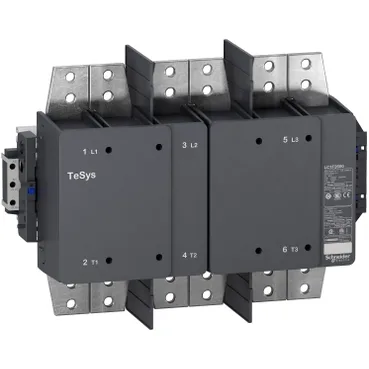
What the 2600 A AC-1 rating means for fit
AC-1 means the contacts close and open at near-unity power factor, so the switching duty is lighter than AC-3 (motor) or AC-4 (plugging/inching), but the continuous current is the headline number. At 2600 A, this is a big-frame contactor — plate-mounted, not DIN-rail — sized for main feeder or large resistive bank switching in industrial power distribution. The control circuit is AC at 40...400 Hz, 440 V nominal, with a pickup range of 0.85...1.1 Uc and dropout at 0.3...0.5 Uc. Inrush power hits 2500 VA at 20 °C; hold-in drops to 45 VA. That coil draw matters for control transformer sizing — expect a momentary surge on closure, then a light hold.
Standards and approvals — what they certify
The LC1F2600R7 carries certifications to EN 60947-4-1, IEC 60947-4-1, UL 60947-4-1, and CSA C22.2 No 60947-4-1 — the core contactor standards for industrial control equipment. These cover the rated operational current, breaking capacity, short-time withstand, and impulse voltage withstand.
Mounting and integration — plate mount, big footprint
Mounting support is plate — no DIN-rail clip on this frame. Dimensions: 519 mm wide, 382 mm high, 251 mm deep. Power circuit connections are via busbar, accepting three cables per pole with a busbar cross-section of 100 x 10 mm. Control circuit uses screw clamp terminals accepting 1...4 mm² flexible or solid. Tightening torque on the power circuit is 58 N.m — that's substantial, requiring a torque wrench.
Short-time withstand and breaking capacity
Rated breaking capacity is 3900 A per IEC 60947-4-1. Short-time withstand current (Icw) is 12 kA for 10 seconds, 9 kA for 30 seconds, 7 kA for 1 minute, 6 kA for 3 minutes, and 4 kA for 10 minutes — all at 40 °C. That Icw profile tells you the contactor can ride through a fault for coordination with upstream protection; the associated fuse recommendation is 2500 A gG at ≤ 440 V. Heat dissipation is 40 W total, with 250 W per pole in AC-1 duty — that's the heat you need to vent from the enclosure.