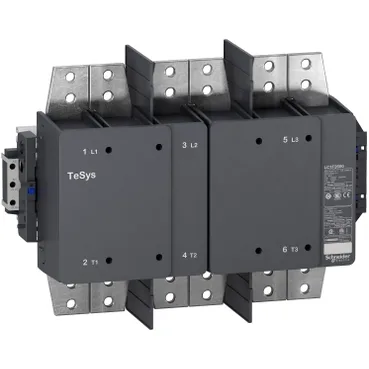
What the 2600 A AC-1 rating means for your load
For motor duty (AC-3) you'd need a different frame or a derating table. The 2600 A figure governs continuous current at <60 °C; above that, thermal derating applies. Control is 250 V DC, with a hold-in power of 18 W at 20 °C and an inrush of 2600 W at the same temperature — the coil driver must handle that cold-start surge.
Lifecycle reality — EOL phase-out
This part is flagged as end-of-life hot (EOL).
Breaking capacity and short-time withstand — selectivity planning
Rated breaking capacity is 3900 A per IEC 60947-4-1, and the short-time withstand current (Icw) is 12 kA for 10 s at 40 °C, stepping down to 4 kA for 10 min. That gives you the numbers for selective coordination with upstream fuses or breakers. The associated fuse recommendation is 2500 A gG at ≤440 V — a useful starting point for the protection scheme.
Standards and approvals — what the certification covers
The contactor carries compliance with EN 60947-4-1, IEC 60947-1, IEC 60947-4-1, JIS C8201-4-1, UL 60947-4-1, and CSA C22.2 No 60947-4-1. That's the full suite for industrial control equipment — the IEC/EN/UL/CSA trifecta covers most global panel builds. Rated insulation voltage (Ui) is 1000 V per both IEC and UL standards. Impulse withstand (Uimp) is 8 kV, overvoltage category III, so it's suited for fixed-installation distribution boards.
Mounting and integration — plate mount, not DIN rail
Mounting is plate-only (no DIN-rail clip on this frame). The dimensions are 519 mm wide, 382 mm high, 251 mm deep — it's a large-frame contactor. Power connections are via bar, accepting up to three cables per pole with a busbar cross-section of 100 x 10 mm. Control circuit terminals are screw clamp, accepting 1 to 4 mm² flexible or solid. Torque values: 1.2 N·m for control, 58 N·m for power — the latter requires a torque wrench.