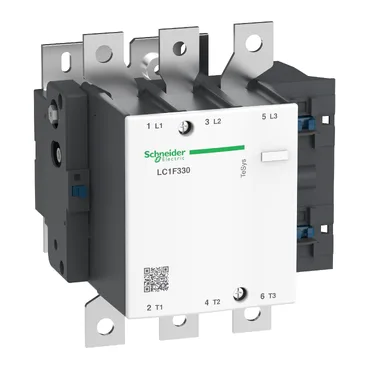
The Schneider Electric LC1F330D7 is a 3-pole TeSys F contactor rated for 400 A operational current in AC-3 duty, with a 42 V AC control coil. This is a heavy-frame contactor — plate-mounted, 206 mm tall, 213 mm wide, 219 mm deep — sized for main motor circuits in industrial panels.
The motor power table gives the real-world match: 160 kW at 380-400 V, 180 kW at 415 V, 200 kW at 440 V, all AC-3. For AC-4 reversing or plugging duty, the rating drops to 59 kW at 400 V — a significant derating that matters if the application involves frequent reversing or inching. The 42 V AC control coil operates across 40-400 Hz, with pickup at 85-110% of rated voltage and dropout between 35-55%. Inrush power is 650 VA at 20 °C; holding power drops to 10 VA. That's a standard AC magnet coil — verify the control transformer sizing for the inrush draw, especially if multiple contactors pull in simultaneously. Plate mounting is specified; no DIN-rail option on this frame size. Standards compliance covers IEC 60947-4-1 and EN 60947-4-1 (the contactor standard) plus IEC 60947-1 and EN 60947-1 (general rules). Overvoltage category III, rated insulation voltage 1000 V per IEC 60947-4-1. The rated breaking capacity is 2640 A per the same standard — that's the contactor's ability to interrupt fault currents, not the short-circuit withstand of the associated fuse.
Integration Notes
Power circuit connections accept lugs or ring terminals for a single 240 mm² cable, or a busbar up to 30 x 5 mm. Control circuit wiring uses screw clamp terminals accepting 1-4 mm² flexible or solid. Tightening torque is 35 N.m on the power circuit and 1.2 N.m on the control circuit — a torque wrench is advisable on the main lugs to avoid hot connections at 400 A. Heat dissipation is 8 W total for the coil, plus 44 W per pole in AC-1 or 31 W per pole in AC-3. At full AC-3 load that's about 101 W total — account for this in panel thermal calculations, especially in a sealed enclosure.