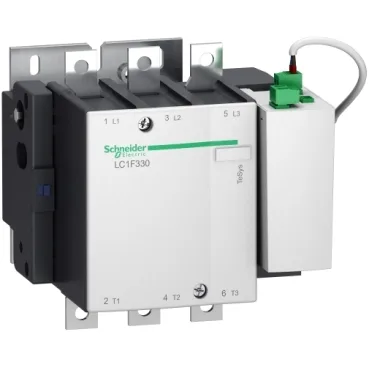
The Schneider Electric LC1F330KUE is a 3-pole contactor from the TeSys F range, rated for 400 A in AC-3 duty (motor switching) at up to 440 V. The part also carries AC-1 (resistive) and AC-4 (plugging/inching) utilisation categories, so it covers resistive heating banks and high-stress reversing duty too. The control circuit accepts 100-250 V AC at 50/60 Hz or 100-380 V DC, with a wide operational window: 85-275 V AC and 85-418 V DC at 55 °C. Drop-out thresholds are 0-60 V AC and 0-45 V DC — useful to know if you're running long control wires where voltage drop is a concern. The electronic coil is PLC-compatible per IEC 61131-2 Type 2, with on-state thresholds of 11-30 V DC.
Mounts to a plate — not DIN rail. The power circuit accepts bar connections (up to 2 cables, busbar cross-section 30 x 5 mm) or ring-terminal lugs for a single 240 mm² cable. Tightening torque is 35 N·m on the power side, 0.6 N·m on the control side — a torque wrench is mandatory on the main lugs; hand-tightening will create a hot joint at 400 A. Dimensions are 219 mm deep, 213 mm wide, 206 mm tall. The 219 mm depth is the panel-space constraint — it's a deep unit, so verify enclosure depth before committing the gland plate layout.
The 400 A AC-3 rating is the headline number, but the thermal current (Ith) is also 400 A at 50 Hz with an average impedance of 0.28 mOhm — that impedance figure tells you the power dissipation per pole: 44 W in AC-1, 31 W in AC-3. Total heat dissipation across the contactor is 2.2-5.5 W, which is modest for this current class but still needs to be factored into enclosure thermal calculations. Rated making capacity is 3300 A (IEC 60947-4-1), and breaking capacity is 2640 A — these are the fault-closing and fault-clearing numbers that matter for coordination with upstream protection. The associated fuse recommendation is 500 A gG or 400 A aM at up to 440 V. Standards compliance covers EN/IEC 60947-1 and EN/IEC 60947-4-1, with overvoltage category III and protective treatment TH (tropicalized). Rated insulation voltage is 380 V per IEC 60947-4-1.