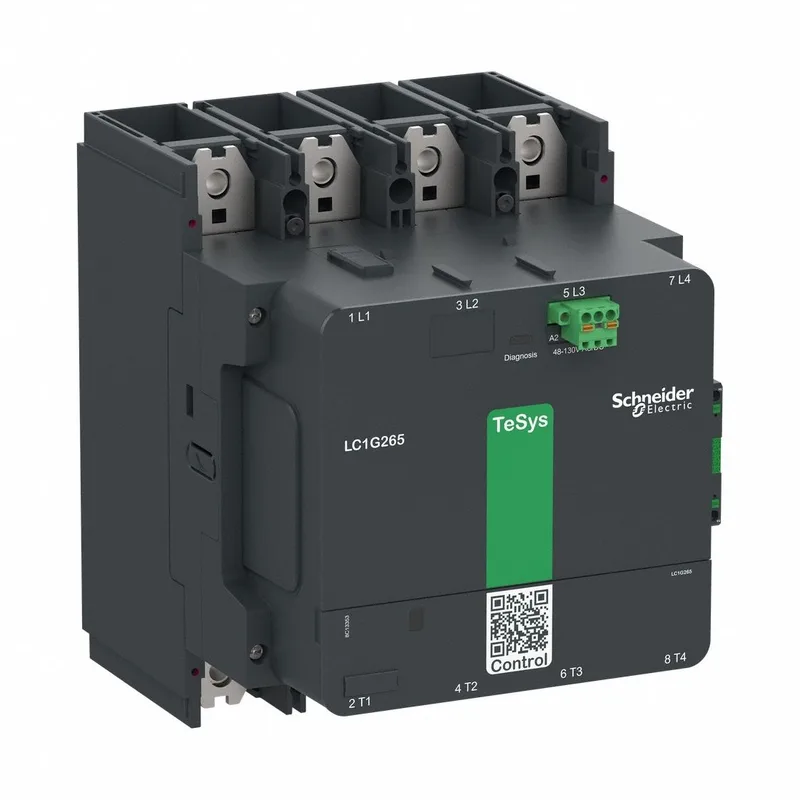
Active production – no obsolescence risk
This LC1G3304KUEN is a current-production TeSys Giga contactor from Schneider, not a discontinued or NRND line. You can quote it into a BOM today without worrying about last-time-buy deadlines.
What you get – ratings and fit
Four normally-open power poles, a 1NO+1NC auxiliary block built in, and a coil that accepts 100...250 V AC (50/60 Hz) or DC. That range covers most global control voltages without needing a separate transformer tap. The coil uses built-in bidirectional peak-limiting – means the inrush spike doesn't radiate into nearby sensors or cause nuisance dips on a shared 24V supply. For a noisy panel floor, that's the difference between a clean start and chasing a phantom fault. Rated for AC-3 duty (330 A), AC-1 (440 A), and several DC utilisation categories. The average impedance per pole is 0.000144 ohm, so expected power dissipation runs 30 W per pole at AC-1 rated current and 16 W at AC-3. That's manageable for a 45 mm pitch plate-mount layout, but keep an eye on ambient derating above 40 °C – the datasheet thermal curves apply.
Mechanical life and vibration tolerance
Rated for 8 million mechanical cycles, which aligns with conveyor, pump, or compressor duty where the contactor cycles every few seconds. Vibration spec: 2 gn contactor open, 4 gn closed; shock 10 gn open, 15 gn closed. That's stiff enough for rail-mounted gear on a machine skid or in a mobile panel. Operating time is 40...70 ms closing, 15...50 ms opening – consistent enough for sequenced motor starts. The coil dropout threshold is 0.1...0.45 Uc, meaning it holds well through sags but drops fast when you want it off.
Power terminals accept a 32x10 mm busbar or ring lugs up to 185 mm²; control terminals are push-in for 0.2...2.5 mm² flexible or solid. Torque the power connections to 35 N·m – loose busbar joints are a common heat source. Mounts on a plate (not DIN rail) with 45 mm pitch between phases.