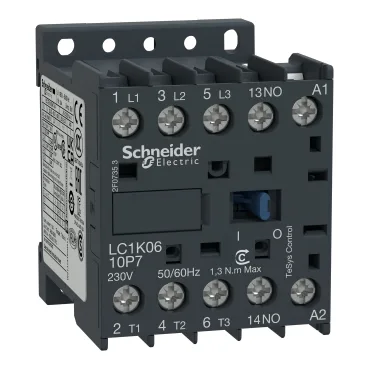
The Schneider LC1K0610M7TQ is a 3-pole contactor from the TeSys K series, rated 6 A in AC-3/AC-3e utilisation category at 440 V, with a 220...230 V AC coil. It is designed for motor control applications — switching three-phase induction motors on and off in control panels and machinery. The AC-3 rating (6 A at 440 V) means it handles starting and stopping of squirrel-cage motors under load — the standard duty for a contactor this size. AC-3e extends that rating for energy-efficient motors with higher inrush. The 3 NO power poles handle the motor circuit; there are no built-in auxiliary contacts on this variant. Screw clamp terminals accept 1.5 to 4 mm² solid or 0.34 to 2.5 mm² flexible with ferrule — typical for control panel wiring up to this current class.
Certified to EN/IEC 60947-4-1, UL 60947-4-1, CSA C22.2 No 60947-4-1, and JIS C8201-4-1 — the core contactor and motor-starter standards across Europe, North America, and Japan. That means it is accepted in panels destined for most industrial markets without additional re-certification. Also meets GB/T 14048.4 for China. Flame retardance rated V1 per UL 94 and Class C2 per NF F 16-101/102 (railway fire protection). These matter when the contactor sits in a panel that must pass a vertical-flame or railway fire-safety audit.
Electrical durability: 1.3 million cycles at 6 A AC-3, but only 50,000 cycles at 36 A AC-4 (plugging/reversing duty). If your application involves frequent inching or reversing, expect a shorter service life — plan spares accordingly. Mechanical durability is 10 million cycles, so the mechanism outlasts the electrical contacts under heavy AC-4 duty. Coil hold-in power is 4.5 VA at 50/60 Hz, with an inrush of 30 VA at 20 °C. The coil operates from 0.8 to 1.15 times the rated control voltage and drops out at 0.2 Uc — standard for this class. No built-in suppressor module, so plan for an external RC snubber or varistor if driving the coil from a PLC output. Minimum switching capability: 5 mA at 17 V for the control circuit. That is low enough to switch PLC-level signals directly, but verify the load current stays above that threshold to avoid contact oxidation in dry-switching applications. Safety reliability: B10d of 1,369,863 cycles with nominal load per EN/ISO 13849-1 — relevant if this contactor is used in a safety-related control system. For mechanical load only (no current switching), B10d rises to 20 million cycles.