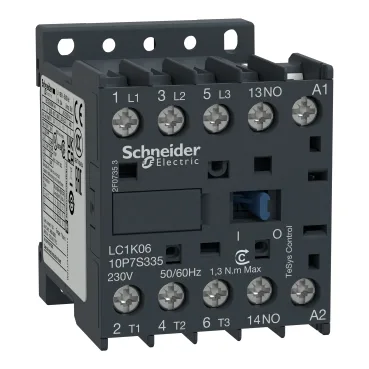
It is rated for AC-3 and AC-4 utilisation categories, meaning it is designed to switch motor loads — AC-3 covers starting and stopping squirrel-cage motors, while AC-4 covers plugging and inching duty. The headline rating is 6 A at 440 V in AC-3, which tells you the maximum motor current it can handle under those conditions; for a 230 V motor the same contactor can carry a higher current, but the 440 V figure is the one that governs the BOM line for 400 V-class systems. The coil is 230 V AC, with an operational voltage range of 0.8...1.15 Uc and a drop-out threshold of ≥ 0.20 Uc below 50 °C. Inrush power is 30 VA at 20 °C, dropping to 4.5 VA hold-in — a standard AC magnet coil curve. The contactor is supplied without a built-in suppressor module, so you will need to add an RC snubber or varistor across the coil if the PLC output or relay driving it requires one. The footprint is 45 mm wide by 58 mm high by 57 mm deep — a compact form factor that fits in a crowded enclosure. Screw clamp terminals accept 1.5...4 mm² solid or 0.34...2.5 mm² flexible with cable end, torqued to 0.8...1.3 N·m.
Lifecycle and compliance — sourcing posture
For a project buyer freezing a BOM, this part is a standard catalog item — no PCN risk, no last-time-buy clock. The multi-standard compliance means one part number covers the panel regardless of whether the end customer specifies IEC or UL.
Durability and mechanical robustness
Mechanical durability is rated at 10 million cycles, while electrical durability depends on the load: 1.3 million cycles at 6 A AC-3 or AC-3e, dropping to 50,000 cycles at 36 A AC-4 at ≤ 440 V. Shock and vibration ratings are given for both closed and open contactor states: the contactor withstands 10 Gn on X and 15 Gn on Y/Z axes when closed, and 6 Gn on X / 10 Gn on Y/Z when open, all per IEC 60068-2-27. The safety reliability figure B10d is 1,369,863 cycles with nominal load per EN/ISO 13849-1, and 20 million cycles with mechanical load only. This matters if the contactor is used in a safety-related control circuit — the B10d value feeds the MTTFd calculation for the safety function.
The non-overlap distance is 0.5 mm, which is the guaranteed gap between NO and NC contacts during transition; this prevents a momentary short-circuit when switching between them in interlocking circuits. Minimum switching capability is 5 mA at 17 V for the signalling circuit — important if the auxiliary contact is used to drive a PLC input with a low wetting current. Below that threshold, oxide films on the silver contacts may not break down reliably, so do not use this contact for dry-circuit logic-level switching. Operating altitude is 2000 m without derating. Above that, the dielectric strength and thermal dissipation both degrade; the contactor can still function but the rated operational voltage and current must be reduced per IEC 60947-1.