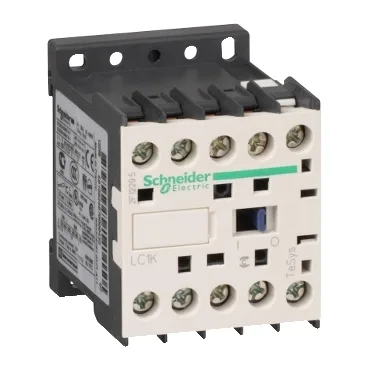
The pole configuration is 2 normally open and 2 normally closed contacts, giving you flexibility for interlocking or signalling circuits without adding auxiliary blocks. The contactor is rated for resistive loads (AC-1), meaning it's suited for heater banks, lighting, or other non-inductive switching where inrush current is minimal.
The AC-1 utilisation category rating at 20 A (Ith) is the continuous thermal current the main contacts can carry in free air. For motor starting (AC-3), this contactor is not the right choice — the AC-1 rating tells you it's built for steady resistive loads, not the high inrush of induction motors. The electrical durability is 0.18 million cycles at 20 A AC-1 under 440 V, while mechanical durability reaches 10 million cycles — the contacts will wear out long before the mechanism does under load. Breaking capacity is rated at 110 A at 415 V and 440 V, dropping to 80 A at 500 V and 70 A at 660–690 V. The associated fuse recommendation is 25 A gG or aM for the power circuit. Heat dissipation is 1.3 W — low enough that you can mount several in a panel without worrying about thermal buildup, but still worth accounting for in a dense enclosure. The contactor measures 45 mm wide, 58 mm high, and 57 mm deep, fitting the standard compact footprint of the TeSys K family.
The screw clamp terminals accept 1.5 to 4 mm² solid wire (single or double), or 0.75 to 4 mm² flexible without ferrules, and 0.34 to 2.5 mm² with ferrules. Tightening torque is 1.3 N.m using a Philips No 2 or flat 6 mm screwdriver. The IP2X finger protection means it's safe for open panel mounting where accidental contact is a concern. The contactor is rated for 3600 operating cycles per hour maximum.