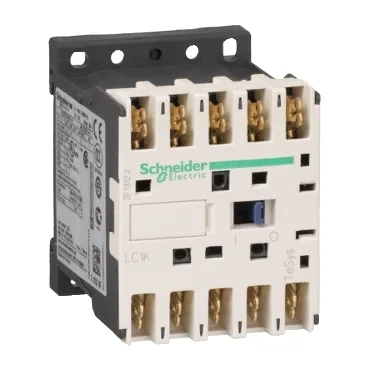
Its headline motor-switching capacity is 9 A in AC-3 utilisation category at ≤440 V, which translates to a 4 kW motor load at 380-415 V and 480 V, and also 4 kW at 500-600 V and 660-690 V 50/60 Hz supplies. At 220-230 V the motor power rating is 2.2 kW. The coil is wound for 230-240 VAC 50/60 Hz and includes a built-in bidirectional peak limiting diode suppressor, so no external flyback diode or RC snubber is needed across the coil terminals.
The AC-3 rating of 9 A is the current the contactor can make and break for squirrel-cage motors during starting and running — this is the number that governs motor switching, not the AC-1 resistive rating. The AC-4 category (inching/plugging) is also listed, so the contactor is rated for the higher electrical stress of reversing or jogging duty, though the thermal capacity should be checked against the duty cycle. The rated operational current entry shows 20 A at unspecified conditions, plus 9 A and 16 A at other points — the 9 A AC-3 figure is the one to use for motor selection.
Coordination and withstand
For selective coordination with upstream short-circuit protection devices, the short-time withstand current (Icw) is rated at 90 A for 1 second on the power circuit, tapering to 40 A for 3 minutes and 20 A for 15 minutes or more. The signalling circuit (auxiliary contact) withstands 90 A for 500 ms and 110 A for 100 ms. These values let a protection engineer verify that the contactor will ride through a downstream fault without welding its contacts, provided the upstream breaker or fuse clears within the Icw time window.