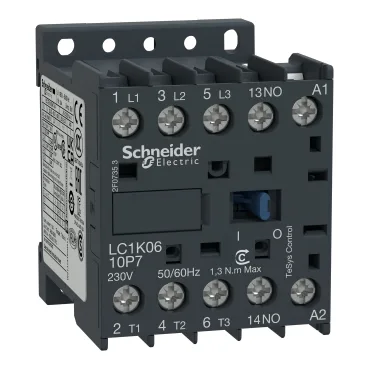
It carries a 9 A rating in AC-3 and AC-3e utilisation categories at 440 V, meaning it directly handles small motor loads like pumps, fans, and conveyors without an external overload relay — though in practice you'll pair it with a TeSys K thermal overload for full motor protection. The 1 NO built-in auxiliary contact gives you a feedback signal for the PLC or a seal-in circuit without adding a side-mount block.
AC-3e is the same curve optimised for energy-efficient motors with higher inrush. The AC-1 resistive rating of 20 A covers heater banks or lighting contactor applications, but the electrical durability drops to 0.16 Mcycles at that load, so it's not a continuous-duty power contactor. For AC-4 (plugging/reversing) the rating is 54 A at ≤440 V, but expect only 0.02 Mcycles — this is not a reversing contactor for frequent jogging. Mechanical durability is 10 Mcycles, which is typical for this frame size. The electrical durability at rated AC-3 load is 1.3 Mcycles — that's the real-world service life before the main poles need replacing. Heat dissipation is 1.3 W in hold-in, so you can fit several of these in a small enclosure without cooking the other components.
The 100 V AC 50/60 Hz coil draws 30 VA inrush and 4.5 VA hold-in. No built-in suppressor module — you'll want to add an RC snubber or varistor across the coil if your PLC output drives it, otherwise the back-EMF can take out the transistor. Operating limits are 0.8 to 1.15 times Uc for pickup, and dropout is guaranteed above 0.2 Uc below 50 °C. Minimum switching voltage for the signalling circuit is 17 V at 5 mA — fine for 24 V DC PLC inputs, but not for dry-contact circuits below that threshold.
Screw clamp terminals accept 1.5 to 4 mm² solid or 0.34 to 2.5 mm² flexible with ferrules. Tightening torque is 0.8 to 1.3 N·m. IP2X finger protection per VDE 0106, so it's safe for open-panel mounting but not washdown areas.