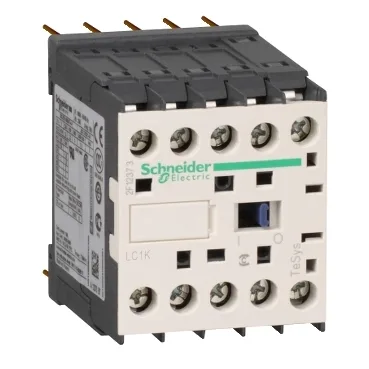
It carries a conventional free-air thermal current (Ith) of 20 A at 50 °C and a rated operational current (Ie) of 20 A at ≤440 V AC-1, with a 230 V AC 50/60 Hz control coil. The contactor's rated breaking capacity reaches 110 A at 440 V, 80 A at 500 V, and 70 A at 660–690 V per IEC 60947, so it handles fault clearing within those limits without welding the main poles. This is a panel-mount component sized for DIN-rail or screw-fixed integration in control cabinets. Its 57 mm depth and 45 mm width fit standard enclosure layouts, and the 1.3 W heat dissipation is modest enough that forced ventilation is not normally required in a well-ventilated panel.
A parametric cross-reference to a current TeSys contactor with equivalent pole count, coil voltage, and AC-1 rating would be the standard approach for a replacement; that selection depends on the specific load and enclosure constraints.
The contactor carries certification to EN/IEC 60947-4-1, GB/T 14048.4, UL 60947-4-1, CSA C22.2 No 60947-4-1, and JIS C8201-4-1, so it is accepted in North American, European, and Asian regulatory jurisdictions. The flame-retardance rating is V1 per UL 94, meeting the requirements for indoor electrical enclosures.
The coil operates on 230 V AC 50/60 Hz with an inrush of 30 VA and a hold-in consumption of 4.5 VA at 20 °C. The control voltage limits are 0.8–1.15 Uc for pick-up and 0.2–0.75 Uc for drop-out below 50 °C, so the coil will hold in on a sagging line down to about 184 V but drops out reliably below about 172 V. The operating time is 10–20 ms for both coil energisation (NO closing) and de-energisation (NO opening). The power circuit has an average impedance of 3 mΩ at Ith 20 A and 50 Hz, and the associated fuse rating is 25 A gG or 25 A aM. The maximum operating rate is 3600 cycles per hour, adequate for most resistive load switching in heating or lighting panels.