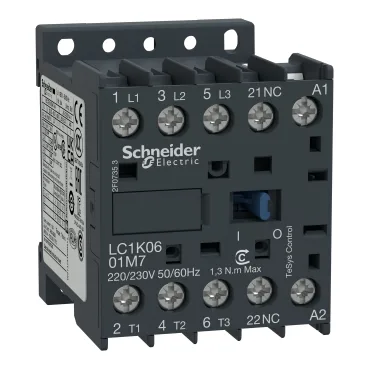
It switches 12 A in AC-3 / AC-3e duty at up to 440 V — that's the rating that governs motor starting, not the higher AC-1 resistive figure. The coil is 100 V AC, 50/60 Hz, drawing 30 VA inrush and 4.5 VA holding. A single normally-closed auxiliary contact is built in (type instantaneous). Screw-clamp terminals accept 1.5...4 mm² solid or 0.75...4 mm² flexible cable.
This part is obsolete per the manufacturer's lifecycle status. If you're holding a legacy panel with this contactor, securing a critical spare now avoids a line-down scramble later.
The 12 A AC-3 rating is the one that decides motor fit — it covers squirrel-cage motors up to roughly 5.5 kW at 400 V. The AC-1 resistive rating (20 A) is higher but irrelevant for inductive loads. Electrical durability is 1.3 million cycles at 12 A AC-3; mechanical durability is 10 million cycles. The contactor meets EN/IEC 60947-4-1, UL 60947-4-1, and CSA C22.2 No 60947-4-1, so it's accepted in North American and European panels. Minimum switching is 5 mA at 17 V, which matters if you're using the signalling circuit for low-level PLC inputs.
The screw-clamp terminals are sized for panel wiring up to 4 mm². No built-in coil suppression module, so if your circuit drives inductive loads near the coil, add a free-wheeling diode or RC snubber externally.