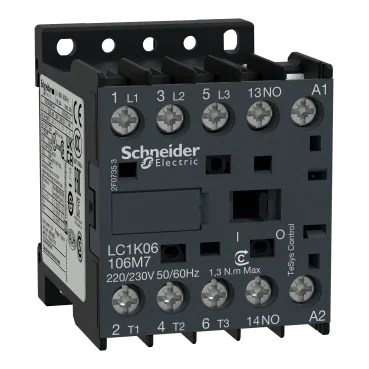
The LC1K12106K7 is a 3-pole contactor from Schneider's TeSys K series, with a 100 V AC coil and one normally-open auxiliary contact built in. It's rated 12 A in AC-3 duty (and AC-3e) at 440 V — that's the motor-switching category per IEC 60947-4-1, so this contactor is sized for starting and stopping a three-phase induction motor up to that current. The same pole set also carries a 20 A AC-1 rating for resistive loads like heaters, and a 72 A AC-4 rating for inching/plugging duty, though the electrical endurance drops sharply at those higher currents — 1.3 million cycles at AC-3, 300,000 at AC-1, and only 20,000 at AC-4. The coil pulls 30 VA inrush and holds at 4.5 VA, dissipating 1.3 W steady-state — that's modest heat for a panel, but worth noting if you're packing several contactors into a small enclosure. Drop-out voltage is guaranteed at 20% of nominal coil voltage or above, so it releases reliably on a sagging control supply. Mechanically it's rated for 10 million cycles, and the shock/vibration specs are solid: 15 Gn on Y and Z axes with the contactor closed, 4 Gn vibration at 5-300 Hz. That means it holds in on a machine that sees regular impacts or conveyor vibration.
Mounts on either a DIN rail or a plate, and the footprint is compact: 45 mm wide, 58 mm high, 57 mm deep. That 45 mm width — three 15 mm modules — is the standard for a 3-pole contactor in this current class, so it slots into a populated panel without surprises. Connections are via ring-tongue terminals accepting up to 7 mm outer diameter lugs, torqued to 0.8-1.3 N·m with a Philips #2 or pozidriv #2 driver. The IP2X finger protection per VDE 0106 means accidental contact with live parts is prevented — standard for panel-mounted gear. The 0.5 mm non-overlap distance between poles is a design detail that ensures arc quenching doesn't bridge phases.
Standards and safety pedigree
This contactor carries approvals across the major industrial regions: UL 60947-4-1, CSA C22.2 No 60947-4-1, EN/IEC 60947-4-1, plus JIS and GB/T equivalents. It also meets the glow-wire and flammability requirements of IEC 60335-1 and -2-40 for appliance applications, with a V-1 flame rating per UL 94. For machine safety circuits, the B10d value is 1,369,863 cycles at nominal load per EN/ISO 13849-1 — useful if you're calculating the MTTFd for a safety function.
What the auxiliary contact gives you
The built-in 1 NO auxiliary switches with the main poles — same 10-20 ms operating time for both opening and closing. No built-in coil suppression module, so if you're driving this from a PLC or a solid-state output, add a flyback diode or RC snubber across the coil terminals to protect the driver.