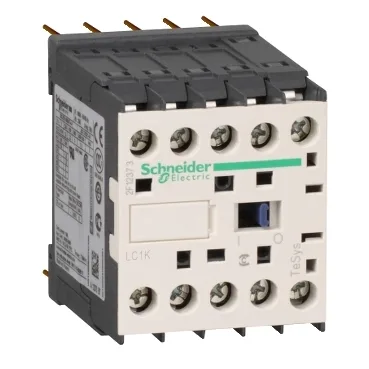
It carries AC-3 and AC-1 utilisation categories, so it's rated for both inductive motor starting and resistive heating loads. The 48 V AC coil means this variant fits control circuits running on that common voltage, not the more typical 24 VDC or 120 VAC.
The headline Ie is 16 A at AC-3 ≤440 V — that's the motor-starting current it can handle repeatedly without welding the contacts. For the AC-1 resistive duty it carries the same 16 A. The motor power table is where you match it to your load: it'll drive a 7.5 kW motor on a 380–415 V supply, 5.5 kW at 440 V, or 4 kW across the 480 V to 690 V range. That's enough for a medium conveyor drive, a decent pump, or a compressor up to about 10 HP. The short-time withstand current (Icw) tells you what fault current the power circuit can survive for a given duration before the contacts might weld or the body fails: 115 A for 1 second, 55 A for 1 minute, 25 A for 15 minutes or more. That's useful for coordination with upstream protective devices — a 16 A contactor that can hold 115 A for a second gives you some selectivity room with a C-curve MCB or a slow-blow fuse.
The 1 NC auxiliary contact is built in, so you get a feedback signal for the PLC or a seal-in circuit without adding a side-mount block. Heat dissipation is only 1.3 W, so it won't cook neighbouring components in a dense panel.